Wednesday, November 20, 2013

Have you tried this plugin?


Zynaptiq who makes unique plugins such as Unveil and Unfilter has released a 1.50 update for their PITCHMAP plugin.

I think PITCHMAP a great tool for producers/remixers/DJs. What do you think?
"PITCHMAP is a demixing-based plug-in that allows changing melodies and harmonies of any mixed musical recording in real-time, either by transforming them to new ones played on a MIDI keyboard, or by setting freely defined target scales. Based on Zynaptiqʼs proprietary MAP (Mixed-Signal Audio Processing) artificial intelligence technology, PITCHMAP can be applied to a wide variety of tasks, including original music production, remix work, correction of tuning issues and creative manipulation of existing recordings."

FEATURES: 


  • Automatic correction of pitch inaccuracies in polyphonic and mixed signals
  • Mapping of source to destination pitches via the GUI
  • Definition of destination pitch grid via live MIDI
  • Process bypass on arbitrary notes selected by their fundamental pitch
  • all of which leaves non-pitched signals like drums virtually untouched
  • Suppression & Extraction of mix elements based on their pitch using Mute Filters via GUI or MIDI control
  • Continuously variable unique synthetic coloration options via parameters Electrify and Purify
  • Polyphonic portamento/glides using the Glide parameter
  • High-speed workflow: options to rapidly generate complex pitch maps using macro controls
  • Snapshot functionality to allow rapid creation of automation
  • Mono/Stereo plug-in supporting 44.1kHz and 48kHz sampling rates (higher rates being worked on)

1.50 update adds the following:
  • Now also supports VST (32/64bit), RTAS and AAX Native (32/64bit) on Mac and Windows, in addition to AudioUnits on the Mac.
  • Improved algorithm.
  • New preset management functionality accessible from within the plug-in GUI allows user presets to be used across all plug-in formats on all platforms.
  • New factory presets organized by application.
  • Completely re-designed automation system for improved automation workflow.
  • New option to enter values numerically by double-clicking controls.
  • Snapshots now contain Sliders and Keyboard states only for better workflow.
  • Enhanced compatibility with Mac OS X Sandboxing.
  • New authorization app for a more streamlined user experience.


Check out these videos showing PITCHMAP being used to manipulate entire songs:

The first one is a quick demo by Protools expert.com's Russ Hughes using Daft Punk's "Get Lucky" and the second is by Zynaptiq themselves demonstrating how they remixed a song with PITCHMAP.


Price USD 399/EUR 369

There is also a side grade offer for USD 199/EUR 179 if you own any of the following software:

1. Celemony Melodyne Editor, Studio or Assistant
2. Antares Auto Tune 7, Auto Tune Live
3. iZotope Nectar
4. Waves Tune, Tune LT


Tuesday, November 19, 2013

Tech Tues.: UAD v.7.4 with Fairchild Limiter Collection and Maag EQ4.


UA has announced the release of the Fairchild Tube Limiter Collection with their v7.4 software update. I use their legacy Fairchild plugin often and look forward to hearing what the new version has to offer. The Side-Chain Filter, Headroom Adjustment and Wet/Dry Mix knob are all welcome additions.
The Fairchild is one of the most sought after compressor/limiters and has been used on many classic records over the years.

Here's a little background on the Fairchild from the UA website:

"The very first Fairchild limiter that audio genius Rein Narma created on Les Paul’s kitchen table transformed the sound of recording forever. Soon, these 20-tube, 14-transformer, 67-pound behemoths were embraced by world-class studios, many of which still employ their vintage Fairchilds despite the increasing difficulty in maintaining these tube-driven tone machines.
For a half-century, the Fairchild 670 — and its aggressive little brother, the Fairchild 660 — have defined popular music’s most revered vocal and drum sounds. In fact, the world’s elite mixers often employ a 670 simply for the “glow” it brings to their final mixes, even without the compression circuitry engaged."

Read my previous post on the UAD Fairchild 670 plugin where I share info and settings I used on a song I mixed for Ricky Martin.


I also used the Fairchild on Mack Wilds debut album "New York: A Love Story."


FEATURES

  • Includes the mono 660 and stereo 670, each with their own sonic attributes and feature sets
  • Models entire electronic path, including tube amplifiers and transformers for complete analog color and behavior
  • Modeled after Ocean Way’s famous, meticulously maintained golden Fairchild channels
  • Lateral-Vertical mode for stereo imaging and balance control
  • Includes custom hardware Stereo Sidechain Link mod 
  • Six attack and release Time Constants (plus additional Time Constant variations with Sidechain Link)
  • Includes all-new “digital only” features: Sidechain filtering, Dry/Wet parallel blend and Headroom
  • Includes artist presets from Darrell Thorp, Michael Brauer, Ryan West, and more
  • Requires a UAD-2 DSP Accelerator or Apollo Interface available from authorized dealers worldwide


>


The 7.4 software update also includes the Maag EQ4 plugin which is known for its amazing top end response.
The words "airy, silky and transparent" are often used to describe the EQ4.


"In a quest for “audio perfection,” Cliff Maag designed the EQ4 to provide unparalleled transparency and top-end presence while maintaining a true, natural sound. Based on his classic — and long-discontinued — NTI EQ3 from the ’80s (which I've used in the past), the EQ4 features Maag’s legendary Air Band control, a major component to the vocal mix chain on Madonna’s Ray of Light as well as Celine Dion’s Taking Chances.
Designed in conjunction with Brainworx, the Maag EQ4 Plug-In is an expertly rendered emulation of this modern classic EQ for your UAD-2 DSP Accelerator or Apollo-equipped workstation."

FEATURES 

  • Exacting emulation of the Maag EQ4®
  • Six bands of equalization, including the famous AIR BAND®
  • Provides unparalleled transparency and top end presence while maintaining the true natural sound of the original signal
  • The vocal sound of Madonna, Celine Dion, Snoop Dogg, and the Black Eyed Peas
  • Endorsing producers include David Reitzas, Dave Pensado, and Dylan Dresdow 
  • EQ adjustments are obtained with minimal phase shift
  • Additional Trim Control (not found on the hardware), for easier level control
  • Constructed for demanding professional applications
  • The interaction of the band passes of the hardware has been fully captured in the plug-in version


Visit UA's website for more info on their latest software update and plugins.


Thursday, November 14, 2013

New Plugin from LVC Audio


PreAMPed is a new plugin from LVC Audio. I like the sound and features of this plugin but wish there was a way to bypass the individual sections. PreAMPed allows you to add color, saturation and apparent volume without increasing the levels of your tracks/busses. I was able to get better sounding drums that hit harder/louder without going into the red (by using the Clip Level control). This was done with the AU version on Logic Pro X. Here's a snapshot of the setting I used.


From the website:


"PreAMPed is a plugin designed to simulate many of the analog qualities of hardware preamplifiers. This includes subtle EQ response curves, low- and high- frequency saturation, differences between left and right signals, crosstalk, noise, transformer/coil impulse response, and saturation and EQ changes due to gain changes. Overall PreAMPed utilizes over forty separate parameters to determine each of the preamp modules within PreAMPed. As a tool, PreAMPed can be used on multiple tracks to provide subtle enhancement to individual track elements, or on overall mixes. PreAMPed includes many controls that are common on mixing consoles and separate preamps."


Preamp Types


1. The Black preamp model features a neutral sounding mid and top end, with a bass response that gradually rolls off from 200 Hz and below. The Black preamp has a fairly even level of saturation across the frequency section, with higher levels of even-order harmonics.
2. The Grey preamp is a modern preamp with a very flat frequency response. There is a gentle low frequency roll-off below 50 Hz, but the bass remains solid with response of approximately -0.5 dB at 20 Hz. Saturation levels are considerably higher with lower frequencies. Higher frequencies have minimal levels of saturation. In general, the Grey preamp model has fewer harmonics than many of the other models, with mainly odd-order harmonics.

3. The Blue A preamp
model has more brilliance than other models, with a gradually rising EQ above 2kHz. The upper bass register is slightly scooped, with a decrease around 125 Hz. The bass saturation level of the Blue A model is considerably higher than upper EQ frequencies, providing more warmth for bass frequencies. The odd-order harmonics fade quickly, with minimal harmonic distortion above 5th order.


4. The Blue B preamp model is similar to the Blue A model, but with an overall cleaners response. There is a slight increase for the high mids and treble frequencies, but the overall response is very linear. Just like most of the other preamp models, the saturation is more stronger with lower frequencies. Both even- and odd-order harmonics are present at a similar level.

5. The Steel preamp model is another relatively flat preamp; however, there is a slight emphasis on upper midrange frequencies and a bass boost. Saturation levels are more evenly spread across the frequency spectrum, although there still remains slightly more saturation in frequencies below 350 Hz. The Steel preamp has minimal even-order harmonics.

6. The Purple preamp model has a pronounces EQ curve, more than most of the other models. There is a reduction of low mid frequencies, with a boost in low bass. There is also an increasing frequencies bump from 2 kHz to 12kHz. This boost is pronounced, with a total gain of +2 dB from 12kHz to 18kHz. Saturation is greatest with frequencies below 100 Hz, and with frequencies in the upper treble range. The Purple preamp also has both even- and odd-order harmonics.

7. The White preamp model has a slow +1 dB peak in the low bass and high mid frequencies. Both the bass and treble edges of the audio spectrum are rolled- off. Despite the obvious peak, the preamp still has a response between +/- 1dB between 25Hz and 20kHz. Saturation is greatest below 100Hz, and even and odd harmonics warm up the entire frequency spectrum.

8. The Red model simulates an older studio-grade preamp. The noise and distortion levels are higher than most of the other preamps. The frequency response has a prominent high frequency roll off, with the preamp being -3 dB at 20kHz. Additionally, sub bass frequencies drop quickly, although there is a gradual boos from 50 Hz through 20 Hz. Saturation is most prominent below 100 Hz, and the Red preamp uses both even and odd harmonics for added saturation warmth. Harmonics fade quickly into the noise floor above 5th order.

9. The Limit preamp model tries to emulate the sound of classic analog compressors and limiters. Although there is no compression occurring, the preamp model seeks to provide the same sonic characteristics of the internal amplifier sections. The frequency response of the Limit model is a rising response, with a slight reduction in bass frequencies and an emphasis on treble frequencies. Although there is more saturation with the bass frequencies, the overall saturation level is more even across the frequency spectrum than most of the other models. Both even- and odd-order harmonics are used for the saturation algorithm.

10. The Tape D model simulates the output of an analog tape devices, but without the mechanical artifacts of tape (e.g. wow and flutter). The bass response of the Tape D model has a boost from 40 Hz to 70 Hz, with a fast roll-off below 30 Hz. The mid-range is scooped, with a prominent emphasis on the high- mid/treble frequencies. The high-end response above 10kHz falls off quickly, to -3 dB at 19kHz. Saturation is high and level across the entire frequency spectrum, with both even and odd harmonics.


11. The Tape R model is a more refined sound than the Tape D model. Similar frequency peaks occur, but to a lesser extent. The overall response is between – 2 dB and +1 dB from 25 Hz to 22kHz. The treble boost in the Tape R model is centered higher in the treble range than the Tape D model. Saturation is more centered with bass frequencies below 200 Hz, but overall there is a fair amount of saturation across the spectrum. Harmonic distortion fades very quickly into the noise floor, with only 2nd and 3rd order harmonics being discernible.


12. The Old model shares many similarities with the Red, Tape D, and Tape R models. Bass response falls quickly below 40 Hz, with a slight peak around 70 Hz. There is also a scooped low-mid response, before a +1 dB increase in the upper midrange. Above 6 kHz, the frequencies drop from +1 dB to -1 dB around 22 kHz. Bass saturation is emphasized, but saturation is evident across the entire frequency spectrum. As with the Tape R model, harmonic distortions fade quickly into the noise floor. Only 2nd, 3rd, and 4th harmonics are noticeable above the preamp’s self-noise.


13. The Modern preamp has a bass and mid boost, but the frequencies are different than many of the other models. The bass boost is due to a slight scooping of the frequencies between 70 Hz and 300 Hz, with a slight increase at 30 Hz. Bass falls quickly below 30 Hz, but remains at -1 dB at 20 Hz. Above 300 Hz, the frequency has a gentle curvature that emphasizes the low and high mids. A gradual roll-off occurs above 8 kHz throughout the treble range. Saturation is fairly even across the frequency spectrum, and many even and odd harmonics are noticeable throughout the entire range.


FEATURES:


  • Virtual preamp emulator with 13 separate preamp models
  • Common hardware preamp controls, including gain, phase, and left/right channel swapping
  • Four-band EQ, including high and low shelf filters, and two parametric mid band EQs
  • Drive control that simulates increasing or decreasing the internal gain of a hardware preamp, while maintaining a consistent output level
  • Stereo controls, including balance, stereo width, and mid/side processing option
  • Adjustable output clipper
  • Additional saturation with controllable high pass filter
  • Selectable oversampling
  • User-friendly graphical input and output metering with VU-style, PPM-style, and loudness meters

Available as AU, VST for Mac OSX and VST for Windows.


Tuesday, November 12, 2013

Tech Tues: Easy way to create melodies from chord progressions


Here's a video from Dubspot instructor Matt Schadetek on how to derive melodies from a simple chord progression. The tutorial was done in Logic Pro but this method should work in almost any DAW. Some producers/musicians might frown on creating melodies in this manner but it could help you overcome writer's block when writing your next hit song.


Monday, November 11, 2013

The CalDigit Thunderbolt™ Station is now available.


The CalDigit Thunderbolt™Station is now available. I previously posted about it and said I would notify everyone once it became available.  

"The CalDigit Thunderbolt™ Station allows Thunderbolt™ enabled Mac users to add a variety of peripheral devices to their computers using a single Thunderbolt™ cable. This interface expansion device includes three USB 3.0 ports, audio in and out jacks, an HDMI out port, and a Gigabit Ethernet port." 


System Requirements

  •  ThunderboltTM equipped Macintosh Computer o Macbook Pro (2011 - Present)
  •  Mac Mini (2011 - Present)
  •  iMac (2011 - Present) 
  • ThunderboltTM equipped PC desktops and laptops • ThunderboltTM Cable (Not Included)
  • Mac OS X 10.8 or later, Windows 7, Windows 8

Price $199

Read my previous post here.


Sunday, November 10, 2013

Good things come in small packages


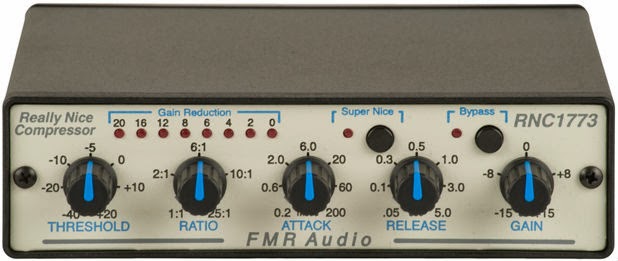
FMR Audio who has a reputation for making great sounding but reasonably priced gear has announced that they are releasing their RNC - Really Nice Compressor (now 18 years old) in a 500 series format. It retains the sound and features of the original but with some added touches. I remember the SuperNice Mode worked really well on background vocals.


From the website:
"As with the original RNC, the RNC500 can exhibit a sonic neutrality while giving the recordist a level-of-control difficult to obtain without adding unwanted artifacts. Unlike the original RNC, however, the RNC500 possesses a sonic "beefiness"—a growl, if you will—that adds a slight, but very compliant, bottom-end to the source material."
"...the main signal path (all dynamic audio processors have two paths: a sidechain/control path and the main audio path) remains firmly in the analog domain thereby avoiding latency and digital conversion artifacts that are sometimes unwanted. Coupled with a faster (40x) processor and higher-resolution (24-bit) arithmetic, sealed switches & relays, multi-layer printed circuit board (PCB) the RNLA500 will deliver smooth, controllable and reliable compression for years to come."


FEATURES:

• Single-channel, 500-series version of the RNC.
• Balanced input & output.
• Linkable for stereo operation.
• Maximum input/output levels of +28dBu.
• Overcurrent protection circuits safeguard 500-series rack operation
  in case of power supply faults.
• 24-bit arithmetic for smoother compression.
• SuperNice & Normal modes.
• Accurate signal level metering via power-saving "dot" gain-reduction display.
• Sealed, C&K subminiature toggle switches.
• Blue-anodized, machined aluminum knobs.


RNC500's Introductory price $299


FMR is also offering their RNLA (Really Nice Leveling Amplifier) in a 500 series format. Like the RNC500 it's not just a duplication of the original but they have enhanced the RNLA  to be as they put it even more "THICK, GOOEY, CREAMY & SMOOTH".


"The RNLA500 is, admittedly, much "gentler" and not as apt to grab'n'run with the signal as other, more "modern-sounding" compressors. Like an old-timey photocell, the RNLA500 is a little resistant to responding right away, but requires the signal to be there for a while to get the photocell to act. That slight hesitancy to respond is one of the key performance parameters that causes opto (and opto-like) compressors to be so coveted. Althought the RNLA500 is a VCA-based compressor, our algorithm controls it in a manner that puts the essence of opto-compressors in a more modern and controllable compressor."

FEATURES:

• Single-channel, 500-series version of the RNLA.
• Balanced input & output.
• Linkable for stereo operation.
• Maximum input/output levels of +28dBu.
• Overcurrent protection circuits safeguard 500-series rack operation 
  in case of power supply faults.
• 24-bit arithmetic for smoother compression.
• Linear & Logarithmic Release modes.
• Accurate signal level metering via power-saving "dot" gain-reduction display.
• Sealed, C&K subminiature toggle switches.
• Red-anodized, machined aluminum knobs.


RNLA's Introductory price $299

Here are videos (by Front End Audio) of the original RNC and RNLA. I will post videos of the new units as soon as they're available:


Friday, November 8, 2013

Analog summing with DAW-driven automation


Greiner Engineering Tools Sum.mation seems like a great choice for a summing unit because of its ability to be fully automated from within your DAW. It can also be used to automate an analog console by placing it on the channel inserts.


From the manual:
"In our continued effort to bring the classic "big studio" experience to the smaller project studio environment, we have designed sum.mation to take full advantage of the incredible control that DAW's have to offer, and combined that with superior analog automation circuitry, for a classic analog mixing experience at a fraction of the cost traditionally associated with this technology." 


FEATURES:
  • 16 channels with left-center-right assign
  • Unique stereo bus design with low noise & distortion + high current output
  • Passive summing node output for experimentation with different amps (Neve, API)
  • Cascade-able design
  • Familiar stereo metering
  • DAW-driven volume automation, powered by a plugin inside the DAW you already own and are already familiar with — no need to learn a new automation package or buy a new computer
  • Balanced channel inputs & direct outputs for insertion into any existing console
  • Super transparent, modern VCA design
  • Infinitely expandable architecture
  • Compatible with any hardware control surface that’s compatible with your DAW
  • Works with your existing DAW automation — no need to buy another computer or learn a new, convoluted automation system
  • Avoids inter-sample latency problems when mixing "in the box"
  • Proven VCA technology as heard on countless hits mixed by top engineers, but with modern circuit upgrades
  • Easy audio connection via industry-standard DB-25 connectors (stereo output on XLR)
  • Simple USB connection — Mac & PC class-compliant (no drivers to install)

Specifications

  • Frequency Response: 20Hz - 20KHz +/- 0.25dB
  • Dynamic Range: 110dB
  • Maximum Input Level: 24.5dBu
  • Input Impedance: 48 kΩ
  • Maximum Output Level: 27.5dBu
  • Output Impedance: 50 Ω

Watch the video to see how the Sum.mation can be easily integrated into your workflow:

Wednesday, November 6, 2013

Another great EQ for your 500 series rack


Trident Audio said they will release a new TREQ 500 EQ based on the Series 80 console which was used on a lot of hit records from the 70's and 80's. Mix Magazine has a PDF brochure for the console here

http://odysseyprosound.com/used-consoles/mixers/trident-80b-original-used/


I love the Trident sound (Ini Kamoze's "Here Comes The Hotstepper" was tracked on a Trident console) and anticipate the TREQ 500 being a big hit with many others in the audio field.

TREQ 500 FEATURES

  • Four Band Eq
  • Sweepable Mid Bands
  • Lo Freq can be switched between 60 and 120Hz
  • Hi Freq switchable between 8 and 12KHz
  • Lo Mid sweepable from 100 to 1.5KHz
  • Hi Mid sweepable from 1 to 15KHz
  • 50Hz Hi Pass Switch
  • Peak Overload LED
  • Bypass Switch
It should be available by the end of 2013.

Price $599


Tuesday, November 5, 2013

Tech Tues: Mixing Kick Drums with Dave Pensado


Here's another quick tutorial from Dave this time focusing on fixing/mixing kick drums.


Friday, November 1, 2013

What do you think of this EQ from IGS Audio?


IGS Audio is working on a prototype 500 series EQ called the OKC Rubber Bands 500.
It's not the first hardware equalizer to offer recall but the one knob/touch screen approach to control of the parameters is definitely different. I will try to get some more info from IGS regarding this EQ and post it in an update. In the meantime take a look at this video:


Thursday, October 31, 2013

SoundToys now supports PT 11 plus Halloween deal on Devil-Loc Deluxe


SoundToys has announced that their plugins have been updated for full compatibility with PT 11's 64bit AAX format and in AudioUnits format for Mac OSX 10.9 Mavericks. The updates are free for all registered users.


They're also having a Halloween special on the Devil-Loc plugin which is $66 today only. The Devil_Loc is an interesting plugin that is described as a distortion compressor/limiter. While being simple to operate it offers various ways to manipulate audio and includes a mix knob for built in parallel processing.

Here's a video by Mitch Thomas of Soundtoys which shows the Devil-Loc being used on drums.


Get the demo here.


Wednesday, October 23, 2013

Do not install OS X Mavericks (10.9) if you use Protools


Avid says its products do not yet support Apple's latest OS update 10.9 aka Mavericks.

From Avid's support page:
"It is not recommended to use Media Composer, Pro Tools or Sibelius with Mac OS X 10.9 (Mavericks) as they are not supported at this time."
"The uninstaller for Pro Tools 10.3.7 and earlier will not work on Mac OS X 10.9. For this reason Avid does not recommend using Pro Tools 10.3.7 or earlier with Mac OS X 10.9 (Mavericks). PTSW-185438.
Increased -6101 errors with Pro Tools 11.0.2 and earlier using Built-In sound output on Mac OS X 10.9. Pro Tools 11.0.x may encounter AAE error 6101 and Pro Tools 10.3.7 and earlier may encounter DAE error 6101 when using the built in sound output on the Mac with OS X 10.9. This occurs with high frequency at HW Buffer sizes: 32, 64 and 128. It occurs with lower frequency at HW Buffer sizes: 256, 512 and 1024. This occurs with Error Suppression enable and disabled in the Playback Engine. The error message is, "A CPU overload error occurred." PTSW-186179."

Read the full page here.

I'm sure Avid is working on an update to resolve the issues.

Keep you posted.


Monday, October 21, 2013

AES 135th New gear announcements - Part 3


Yesterday was the final day of the AES 135th Convention. Here are some more gear features.

ELECTRONAUT M97


The look of the Electronaut M97 is stunning and if it sounds even half as good as it looks it will be highly sought after by sonic aficionados. The M97 is a Vari-Mu design but it has some unique features. Price TBA.

From the press release:

"Electronaut set out to design a new variable-mu compressor with no regard for the specific character of other historical variable-mu compressors..... a compressor whose capabilities were as good or better than the state of the art, and whose features provided improved usability and a more enjoyable experience."
"The M97 vari-mu stage is arranged as four quadrants, each consisting of three tube sockets: one 9-pin wired for 6386 tubes, and two 7-pin wired in triode-mode for 6BA6 and equivalent tubes. Each quadrant has a switch that configures the 7-pin sockets for either 6V or 12V filaments. This gives the user maximum flexibility and provides the choice of which tube type to use in each of the four sections, allowing a myriad of possible combinations."
"Electronaut designed a very low distortion sine wave generator, and a high-precision notch filter. When the Tone/Notch switch is engaged, the tone is injected into the input, the output is routed through the notch filter, and any residual signal (THD+N) is displayed on the meter. Balancing the compressor simply involves turning the balance control until the lowest distortion level is displayed. (The output is muted whenever the Tone/Notch is activated.)"
"Electronaut designed a high-voltage detector circuit that essentially converts the dB meter to a voltage meter, with a 1-percent per-step scale. If the meter is set to “B+” mode, a perfectly calibrated power supply will display a level aligned to the top center “0″ position. Each step above or below this position corresponds to a 1% error from the target 325V specification. It’s best to keep the power supply calibrated to within +/- 5%, and this can be checked effortlessly by switching to the B+ meter mode."


M97 Features

  • Single Channel but stereo linkable when using 2 units
  • Heavy duty Single Stage Vari-Mu design
  • Can accommodate multiple tube types
  • Unique display meter based on Dorrough Electronics shows input, attenuation, output gain reduction and B+ supply voltage
  • THD+N measurement built in
  • Tone/Notch switch used to calibrate distortion levels and verify compression ratios
  • Variable knee/slope
  • Separate Attack, Release knobs
  • 120Hz HPF Filter switch
  • 3-way Bypass switch
  • Input Attenuator Knob
  • Function switch to select stereo link modes
  • No capacitors in signal path


Neve Genesys Black


AMS-Neve has announced an updated version of their Genesys console. The Genesys Black is a
digitally controlled analog console that integrates with your favorite DAW.


For those who like the look and feel of an analog console but lack the space for a large frame mixing desk this is a good option. The integrated screen and DAW control is a definite plus.

From the website:
"The Genesys Black includes legendary microphone preamplifiers and highly revered analogue circuit design. The extensive digital control and connectivity puts Genesys Black at the creative heart of your studio. It offers 8 channels of mic/line preamps, 16-channels DAW/Tape monitoring, hands-on DAW control for Pro Tools, Nuendo and more, 8 channels of Neve 4-band EQ, 8 channels of Neve VCA dynamics and A/D/D/A conversion via MADI, AES and FireWire formats..... A central touch screen, 8 auxiliary buses, 8 group buses, 2 main outputs, 4 effects returns, comprehensive metering, 5.1 monitoring, 2 cue mixes, talkback services and an integrated footprint with internal power supply..."

Rumored price $19,995.


SSL Matrix2


SSL has also updated their Matrix small frame console/DAW controller to the SSL Matrix2.


From the website:
"Hardware device inserts can now be loaded directly from the console hardware controls (previously this was done only via the remote browser software) with an intuitive new interface that facilitates loading individual processors, A/B comparison of different processors and building processor chains. The Matrix remote browser software has also been re-designed to provide a new ‘drag and drop’ style interface for loading processors and building chains. A powerful 'Fader Linking' system has been added to the console which allows two or more faders to be grouped, to facilitate stereo or 5.1 channel control or subgroup style mixing. The A-FADA (Analogue Fader Accesses DAW Automation) summing system used in Duality, AWS and the new SSL Sigma rack has been introduced to enable the analogue faders of Matrix2 to be driven by automation data from your DAW. A-FADA enables channel automation to be performed entirely in the analogue signal path but with the advantages of DAW automation data editing. The addition of A-FADA to Matrix2 facilitates project portability between different SSL products. The previously optional 5.1 output card will now be included as standard pre-fitted in all units.
A collection of smaller new features have also been added including; 'partial TR setup save & import' which allows selected parts of the console setup to be saved and imported as setup templates, new Preset insert matrix 'scenes', Preset insert naming tools, "automatic dB readout" for Pro Tools users (allowing the scribble strip to automatically display fader values upon touch), modifier key 'press and hold' functionality for Cubase/Nuendo users and new DAW templates for Presonus Studio One and Ableton Live!"

SSL will make all the new features except for the 5.1 card a free update to all existing customers.

Available December 2013


Empirical Labs Fatso EL7x


Another popular unit that has been updated is Empirical Labs Fatso. I'm a big fan of Dave Derr's products and have used both the hardware and plugin version of the Fatso ( I also like the Distressor and Lil Freq.) If you own the original Fatso it can be updated to the new version.

"ELEVEN is a new compressor for the Fatso, replacing the old GP Ratio, and emulates the famous UREI 1176LN in 20:1, with the slowest attack, and fastest release. This 1176 setting has been used on countless hit records through the decades. With the slower “1176” attack, the transients keep the dynamics present, while the high ratio, can radically limit the dynamic range of any source, making it present and sitting in a nice little place in your mix. One can slam it, or just touch it with a few dB of compression. You will find it great on Vocals, Bass, acoustic guitars, drum room mikes, pianos etc..... ALL existing older “Fatso Jr’s” can be modified to change the GP ratio to the new ELEVEN ratio. In addition, all Fatsos shipped from Empirical Labs since June 2013 have had the ELEVEN ratio already installed in the circuit, under the GP ratio, so if you bought a Fatso recently, you probably already have the equivalent EL7-X circuitry."

NEW FEATURES

  • A new ratio “Eleven”, which emulates a favorite classic compressor setting.
  • New Two Color Front Panel
  • Improved Logic
  • Separate TRACKING LED, more intuitive display.
  • Backwards stepping when a front panel button is held.
  • New extended stereo link functions. More choices of how to lock compressors.
  • Cooler running Logic Circuitry, resulting in an overall cooler operating temperature.
  • Improved overall noise floor, due to lower logic power consumption.


Here are videos of the original Fatso hardware and the UAD software versions:


Saturday, October 19, 2013

AES 135th New gear announcements - Part 2


The AES 135th Convention continues today through Sunday. Here's some more gear that's being shown there.

PHOENIX AUDIO - NICERIZER JUNIOR


The Nicerizer Junior from Phoenix Audio (Booth 3157) is based upon their Nicerizer 16 which is a "2U 19″ rack mountable 16 input and 4 output Summing Mixer, that can be stacked and linked in any multiple and various configurations to give high quality, line-level, Class A, discrete buffering, summing and mixing."

FEATURES
  • 16 channels of our Class A, discrete, truly balanced transformerless input stage.
  • Our proven and loved Class A, discrete, transformer balanced output stage (DSOP-2).
  • Individual pan control for each channel with detented/steppd pots for extra control (16 x Pan pots)
  • 16 x Balanced Input via D-sub inputs, wired as Tascam DA88 standard. Can accept balanced or unbalanced input with no -6dB loss.
  • 4 x mix busses (Stereo Mix Bus)
  • +8dB Boost button on each channel.
  • Master mix bus output level control.
  • Switchable for each channel and Main Output
  • Main Outputs on Balanced XLR’s
  • Maximum Output Level of +26dB.
  • Huge headroom available on all channels.
  • All units are wired with PTFE silver military grade cable


SKNote VASTASO


I have to admit I'm not very familiar with the company SKNote but the look and features of this unit piqued my interest. The Vastaso is described as a "stereo compression and distortion unit with sidechain EQ and external sidechain input". I can see using this as part of a DAW/Summing chain and also for tracking. A great way to add life to sterile sounds.

FEATURES

- 12 stereo compression models (opto to vintage to modern)

- 12 stereo distortion modes (linked to compression)

- stereo with a single set of controls

- balanced inputs/outputs

- analog-computing modeling

- internal sidechain EQ (highs and lows)

- external (line level, balanced) sidechain input

- 16 VCAs inside

- feed-forward and feed-back compression

- limiting

- peak and rms detection

- special compression modes

- huge needle meter for compression

- bi-color led indicator for distortion

- 3 rack units

Special AES 2013 introductory offer: $999 (+ VAT, taxes, shipment)


Slate Digital's VIRTUAL MIX RACK


Slate Digital has announced the VIRTUAL MIX RACK which should be available to purchase in January. Price TBA.


The TLM 107 is the latest microphone from Neumann (MSRP $1700). It uses a novel approach when changing mic settings "... all of the microphone switch functions are controlled through an elegant, wear-resistant navigation switch. The contemporary, intuitive operating concept includes an illuminated pattern display in the chrome ring, with the Pad and Low Cut status LEDs positioned to the left and right. The switch and display are located on the rear of the microphone so as to not distract singers. After 15 seconds, the display is turned off automatically, allowing the TLM 107 to be positioned discretely on the stage."


FEATURES

  • Multipattern large diaphragm microphone with 5 polar patterns (omni, wide cardioid, cardioid, hypercardioid, figure-eight) 
  • Navigation switch with LED illuminated display for polar pattern, PAD and low cut 
  • Sound characteristics: transparent, natural reproduction of human voice, outstanding transient response 
  • Balanced sound in all 5 polar pattern settings 


Dave Hill of CraneSong ( I am a big fan of their HEDD 192)  is a person who needs no introduction in the audio world and he has announced the impending release (Dec./Jan) of his newest offering the Syren 500 series Tube Mic pre.


To be continued.....


Friday, October 18, 2013

AES 135th New gear announcements - Part 1


The AES 135th Convention is in full swing at the Jacob Javits Center, New York. For those able to attend its gear heaven, workshops on many different audio related topics plus you get to meet the people behind some of your favorite gear.

Here's some of the new products that have been announced for AES:

BetterMaker EQ 542.


FEATURES

  • Stereo Parametric section, two paramtric filters offered in combined, matched stereo.
  • High pass section, 24 dB/oct filter with selectable frequency
  • Low pass section, 12 dB/oct filter with selectable frequency
  • Full digital recall with 399 cells for your own presets.
  • USB link to use the EQ’s just as you would use a plugin, including Automation.
  • Free AU, VST, RTAS, (AXX soon) 32 & 64 bit plugin controller
  • Steel screen isolators for maximum separation of digital and analog sections
  • You can connect up to 99 EQ542′s to one D.A.W. and control them with dedicated plugins.

Check it out at AES New York. TransAudio Booth no. 3132.


Now there's no excuse not to have a 500 series rack. Lindell Audio has announced a 3 slot 500 Series power supply for only $279?!!.


Lindell 503 - 3 Slot 500 Series power supply


FEATURES

  • 800mA of power per slot
  • Gold plated XLR inputs and outputs
  • Built in no noise Universal Power Supply: 90-250V
  • Overload protection
  • Short circuit protection
  • Power rail led indication
  • Aluminum cabinet
  • Lightweight
  • Steel M3 threads
  • Comes with a neoprene gig bag
There's also a 506 and a 510 ($549 for a 10 slot is insane!!)


API has announced a brand new console called THE BOX.


FEATURES

  • Two (2) input channels with mic/instrument/line preamp, HP filter, & integral 550A EQ
  • Two (2) input channels with mic/instrument/line preamp, HP filter, & 500 slot
  • Two (2) compressors assignable to input channels or program bus with stereo link
  • Sixteen (16) summing channels (20 channels during mix)
  • Stereo program bus with master fader, insert, and external input
  • One (1) stereo and (2) mono auxiliary sends/buses
  • Stereo cue send/bus & headphone system
  • PFL, AFL, and solo-in-place solo modes with stereo solo bus
  • Full-featured monitor section that supports two stereo monitor systems
  • Talkback system
  • Comprehensive rear panel connections with balanced inputs and outputs
  • Integrated power supply


Shelford 5051 - Inductor EQ / Compressor


Shelford 5052 - Mic Pre / Inductor EQ


That's it for now I will do another post tomorrow on some of the other exciting new gear announced for AES.