Thursday, March 31, 2011

Apogee Duet 2: 2 IN x 4 OUT USB Audio Interface for Mac


Duet 2 is built upon 25 years of Apogee Research and Development. Using cutting-edge components and a state-of-the-art user interface, Duet 2 is the most advanced portable recording design available. A full-color OLED display is only the beginning. Duet 2 features balanced outputs, independent speaker and headphone outputs, configurable touch pads and what many thought impossible, improved sound quality. Duet 2 can record from sampling rates of 44.1 to 192kHz.

Duet 2 is based upon the unprecedented research which made Apogee’s flagship interface, Symphony I/O, a reality and the finest I/O in the world. Duet 2 with USB connectivity features extremely low latency, higher sampling rates and incredible sound quality.


No matter where your creativity takes you, Duet 2 is the best solution for recording music to a Mac. With a new breakout cable design and optional breakout box, Duet 2 is even more streamlined than the original. Duet 2 will transform your Mac into a professional recording studio. World-class microphones are completely at home, sounding absolutely amazing when connected to Duet 2‘s Mic-Pres. When it's time to mix, Duet 2’s output quality lets you hear your recordings with incredible detail as you put the finishing touches on your musical projects like a pro. Duet 2 sounds so amazing, you won’t want to listen to your iTunes library without it. 


Duet 2 highlights

  • Completely redesigned mic preamps and converters
  • 4 outputs, Independent speaker and headphone outs
  • Balanced outputs
  • USB 2.0 high speed connectivity
  • 24-bit/192kHz recording
  • Full color OLED display
  • Configurable touch pads
  • Maestro 2 software
  • Breakout box (sold separately)
  • Redesigned Breakout Cable
  • Soft Limit

Features & Specs

  • USB 2.0 Mac audio interface
  • 2 Combination Line/Mic/Instrument inputs
  • 2 Balanced line outputs, +20 dBu maximum output level
  • 1 Independent 1/4” stereo headphone output
  • 2 Microphone preamps with up to 75dB of gain
  • A/D and D/A Conversion at 24-bit/192kHz
  • Top panel high resolution OLED display
  • Multi-function controller knob
  • Two assignable top panel touch pads:
    • Mute speakers, headphones or all outputs
    • Assign headphone to outputs 1-2,3-4 or low latency mixer
    • Dim speakers, headphones or all outputs
    • Sum to mono speakers, headphones or all outputs
  • Selectable 48v phantom power, Soft Limit and phase invert


Price: $595 US
Availability: TBD

Wednesday, March 30, 2011

Breast Implant Write-Off? Outrageous Tax Deductions the IRS Has OK'd ... Or Not

Unfortunately, our current tax system is like a big game, with taxpayers looking for every deduction they can find that will help reduce their tax bill.

While you should definitely take advantage of every deduction that you're entitled to, there's also a limit on how far you should push things. And as in any game, some players try to bend the tax rules ... a little too far.

Check out some of these, ahem, "interesting" deductions your fellow taxpayers claimed. The IRS refused some of these, but wait until you see the ones that were actually accepted!

Read on and see if you can guess which outrageous tax deductions Uncle Sam allowed ...

Dairy Cows ... on a Safari?

The owners of a dairy business went on an African Safari and tried to write the cost off as a business expense.

They justified the deduction by saying that many of the dairy's promotional activities and marketing efforts included wild animals.

We're not sure that "wild dairy cows" exist, but guess what?

The IRS agreed that the trip was "ordinary and necessary," and the deduction was allowed.
Looks like these folks really know how to "milk" the system ...

Beer Good, Whiskey Bad...

A gas station owner gave his customers free beer and tried to write it off as a business expense.

Do you think the IRS took kindly to that?

The whole thing ended up in tax court, but the final ruling said the beer was a legitimate expense and deduction.

Interestingly, an Oklahoma businessman tried to deduct several cases of whiskey that he gave to his clients -- as "entertainment." This deduction, however, was flatly denied.

If you think that makes no sense, this next deduction is sure to fire you up ...

Burnin' Down the House...

A Pittsburgh furniture-store owner had tried to sell his business for years, but there weren't any takers.

Frustrated by his lack of success, he hired someone to burn the store down. He collected $500,000 from the insurance company for his misguided effort.

Brazenly, the man went on to deduct the $10,000 that he paid the arsonist as a "consulting fee." An IRS audit two years later ended with both men in prison.

Apparently, the IRS agent who handled the case was hot under the collar about the whole thing. Ba da bum.

silicone breast implant - tax deductionsThanks, Doc! Come by for a Swim Anytime ...

A doctor told his emphysema patient that the sick man needed to start exercising. The patient decided to install a swimming pool at his home, and then he deducted the cost as a "necessary medical expense."

The IRS agreed with the deduction, not only for the pool, but also for the various chemicals, cleaning, heating and upkeep. No word on whether he could write off his suntan lotion.

Did She Tango Her Way Home?

While the IRS looks favorably upon swimming pools, it doesn't look like you'll see the tax man on the dance floor anytime soon.

Despite her thinking that learning how to dance would improve her varicose veins, the government wasn't about to let this taxpayer deduct the cost of her dance lessons. The reason? "Not medically necessary."

The IRS also frowns up dance lessons for the treatment of arthritis or nervous disorders.

No, You Can't Deduct Fido's Babysitting

There are about 75 million household dogs in the U.S. That means millions of pooches are left at home alone each day.

To ease his pup's unhappiness, one taxpayer hired somebody to come to his home and watch his dog while the owner went off to work.

The IRS howled, however, when the taxpayer tried to deduct the cost by using a day-care tax credit intended for children and legal dependents. Pets do not qualify.

Maybe the IRS just prefers cats ...

"Here, Kitty-Kitty-Kitty!"

These junkyard owners had finally had enough of a nasty snake and rat problem, so they cleverly set out bowls of pet food each night to attract wild cats.

The cats not only ate the pet food, they also took care of the junkyard's unwanted guests.
Because the wild cats made the business safer for customers, the pet food was deductible as a business expense.

Sounds like the purr-fect solution!

The Bigger the Better?

Exotic dancer Chesty Love (you can't make this stuff up!) wrote off the expense of having her breasts enlarged. She claimed it was a business expense since a bigger bust-line would equal bigger tips.

The IRS agreed, declaring that her enhanced chest was a stage prop essential to her act. Seriously.

We've had a little fun with this topic, but the truth is that taxes are no joke. This tax season be sure you pay your fair share but not one penny more. Start by making sure you take every single deduction to which you are entitled.

Nationwide, 4.1 million taxpayers missed taking education credits and deductions, and 7.3 million taxpayers missed claiming the Earned Income Tax Credit, and it goes on and on.

When you do take them, make sure your tax deductions are airtight. Finally, before you file, be sure you have accounted for these important 2010 tax law changes.

Vimeo App for iPhone Includes Editing Tools


"Video-sharing site Vimeo has finally introduced an official iOS application. The app provides access to Vimeo’s library of online video, but it emphasizes the ability to record, edit and upload your own videos to the service first and foremost. That’s a wise move for a service that has to differentiate itself from clear market leader YouTube, which comes pre-installed on every shipping iOS device....."

http://gigaom.com/apple/vimeo-app-for-iphone-includes-editing-tools/

Redmatica releases GBSamplerManager for GarageBand iPad


Transfer your GarageBand songs from the iPad using iTunes, then drag the songs to GBSM to manage/edit their Sampler instruments or add new ones. Once you are satisfied, drag your song back to iTunes and transfer to the iPad.

Sampler instruments and samples can be copied between songs or to the desktop, where you can use them in Logic or GarageBand for Mac, or simply build a library. Similarly, you can copy your (EXS) sampler instruments from Logic and GarageBand for Mac to your GB iPad songs. Creating new sounds and adding them to your GarageBand for iPad songs is very easy: drag a sample to GBSM, and it will create a sampler instrument automatically for you. There are literally tens of thousands of commercial and freely available EXS24 sounds available on the internet. Drum loops, vintage analog synths, everything. With GBSamplerManager you can easily use them in your GarageBand iPad projects. And if you want to migrate your hardware and software synth sounds to GarageBand iPad you can purchase the simple one-click AutoSampler application on your Mac to create your own sampled sound library (Autosampler application available separately from Redmatica). The Sampler instruments from GarageBand iPad are compatible with GarageBand for Mac and Logic. With GBSM you just have to select the instruments you want to take to the Mac and drag and drop them to your Mac. GBSamplerManager also includes a basic, intuitive editor for simple (one sample) instruments, so that you can edit them with the full comfort of your large Mac screen. Add loops, set crossfades, set crossfades shape, change the envelope, fine tune your sample in the simplest possible way. For more complex instruments, GBSamplerManager integrates with Keymap Pro and Keymap One (both Redmatica products available separately) order to give you direct access to the most advanced sampled instruments editors available today anywhere. And if you just want to browse your sounds on your Mac, click a button, and GBSM will let you play your instruments from a MIDI controller attached to your Mac. 

GBSM Requires a Mac running OSX 10.6 with 2GB RAM or more.


GBSamplerManager is available now on the Redmatica Online Store at 3.99 Euro / 4.99 USD.

Sebatron VMP-2000e VU Class A Dual Valve Mic Preamp and DI + EQ

The Sebatron Valve Microphone Preamplifier has been designed to bring back that Classic tone to digital recording and multitracking.
The Sebatron VMP series (Valve Microphone Preamplifier) is available in two channel (with or without VU) and four channel formats ... the vmp-2000e , vmp-2000eVU and vmp-4000e.All circuitry is High Voltage Discrete Class A for optimal headroom, wide audio bandwidth and maximum transient response.
The valve Anode Voltage is approximately +300VDC.
Microphone inputs are transformer coupled for an organic 'pleasant to the ear' flavour and all signal gain is provided by the valves..Direct Inputs are available for Bass, Guitar, Keyboards and running line level signals through etc.The two-band switched Passive Equalization network and variable colour control via the Pad switches allow the user to carefully sculpt the signals when dealing with the clinical and lifeless quality of Digital (or otherwise ) recordings.Such is the organic quality and musical colouration of the VMP series circuit that they are often used to run stems (sub mixes) or full mixes through to obtain that characteristic 'Analog glue' that Digital recording systems simply cannot produce.Sebatron preamplifiers are being used everyday by Professional hi end audio studios all around the world.
The VMP Series of preamplifiers from Sebatron is aimed at filling in the gap between ‘transparent’ amplification and ‘coloured’ or character preamplifiers. They can be driven lightly for pure, almost transparent sounds with just an edge of true valve tone or slammed into thick distortion, with a spectrum of colours available in between.
Each VMP channel consists of
* a transformer balanced microphone input for reliability, ease of use and sound quality
* individual phantom power with LED indication
* DI for direct instrument or line input
* passive switchable EQ for the extreme high and low registers - very practical when tracking
* a 12AT7 vacuum tube run at a proper high tension providing all of the active gain
* switchable PAD control which varies negative feedback around the valve, controlling colour
* solid state, discrete Class A output stage, powered by a high voltage rail for superior headroom and transient response
* switchable output phase
* XLR and TRS balanced outputs
All Sebatron products are designed with reliability and long life in mind.
All units are housed in steel chassis’ with quality hardware. Everything is hand built using single sided circuit boards and discrete components for easy servicing. We refused to use integrated circuits because of their lack of character and other limitations they impose on a circuit. It is easy to produce purity from a chip, but it is nigh on impossible to squeeze out soulful tones. A properly tuned valve circuit (i.e. not a starved tube used as an effect) subtly compresses and harmonically enhances the signal in an organic and musical fashion, providing the warmth and punch associated with tape that is missing from purely digital systems. Sebatron VMP preamps have also proven popular as line level devices for adding organic richness to synths, amp simulators, stem mixes or even over a complete mix.

Rascal Audio - Analogue ToneBuss


Tone. It's what Rascal Audio's Analogue ToneBuss is all about. Not bells and whistles -- not a bunch of unwanted features you don't need and won't use. Just large, full, detailed, opulent analogue TONE. The kind you'd expect from a classic, all-discrete recording desk of the early 1970's. The Analogue ToneBuss uses discrete, class-A circuitry with custom wound input and output transformers specifically designed to provide the larger-than life punch and authority of the most coveted vintage signal paths. Additonally, the Analogue ToneBuss supports the instant recall of your DAW by offering minimal, practical facilities, all on logable, rotary switches, so you can use your time for mixing instead of wasting it trying to recall your previous settings. If you'd love your DAW mixes to possess the dynamic richness and spacial definition of those mixed on classic, large-format consoles, then look
no further. Rascal Audio's Analogue ToneBuss delivers with simplicity and elegance.
The Analogue ToneBuss is available in 16-channel and 24-channel models.
Front panel controls include pan switches for channels 1 thru 4 and switchable direct thruputs for channels 5 and 6.
The pan controls, each of which affects a stereo pair of inputs, allow the user the option of panning individual signals, such as kick, snare, bass, and lead vocal, to the center of the mix in the analogue domain yielding much more focus and definition while simultaneously allowing the user to incorporate their favorite mono processors during mixing. The unique channel 5 and 6 direct throughputs give users without a 'proper' patchbay the ability to hardwire a couple of their favorite outboard processors to their D/A outputs. When editing simply switch to the 'DIR' position, process and re-record the audio, and then switch back to 'L' or 'R' when it's time for mixdown.

FEATURES
  • CLASSIC ANALOGUE CONSOLE TONE FOR THE DAW STUDIO
  • ALL-DISCRETE, CLASS-A TRANSISTOR CIRCUITRY
  • CUSTOM INPUT AND OUTPUT TRANSFORMERS FOR OPULENT 'IRON' TONE
  • OUTPUTS: MAIN L/R, MONITOR L/R, CHANNELS 5 AND 6 DIRECT THRUPUTS
  • BALANCED INPUTS AND OUTPUTS VIA DB-25 CONNECTORS (TASCAM PINOUT)
  • AVAILABLE IN 16-CHANNEL AND 24-CHANNEL CONFIGURATIONS
  • PANNING FOR CHANNELS 1 THRU 4 IS SWITCHABLE "L/R" OR "C" (CENTER)
  • SWITCHABLE THRUPUTS ON CHANNELS 5 AND 6
  • SIMPLE, ELEGANT FUNCTIONALITY USING ROTARY SWITCHES FOR EASY RECALL


Elysia Alpha Compressor


"The alpha compressor is a mighty tool for professional dynamics processing. Featuring innovative functions and providing absolutely uncompromising sound quality, it sets new standards for  enhancing any kind of audio material. It offers M/S processing, parallel compression, limiters, as well as sidechain and audio filters, just to name a few....."


Tuesday, March 29, 2011

Kush Audio's Clariphonic Parallel Equalizer


Instantly & effortlessly add pristine analog focus, detail, clarity, and air to any sound


"The Clariphonic Parallel Equalizer is a mastering grade, parallel shelving EQ matrix with a new filter shape that allows a single band to lift both the top and the bottom, simultaneously but asymmetrically. To my ears the top gets lifted at about a 3:1 ratio compared to the bottom, but I have yet to test it to see what the proportions actually are.

The signal path is super minimal --- it's primarily a capacitance network made up of Wima and Panasonic caps --- but the switching architecture is extremely cool and allows for a lot of new possibilities. I wanted to create an eq that was artistic and right-brain in nature, to get you to think about sound in terms of textures and colors rather than numbers.

To that end, there are 2 engines per channel, the Focus Engine and the Clarity Engine, each of which can have 1 active band. I call them engines because they work on both ends of the spectrum despite being a single band. Anyway, there are 4 unique bands to choose from in each engine, each with its own slope and corner on top and bottom. So essentially it's a dual channel 2-band eq that behaves like a 4-band hi/low eq, with 8 available filter shapes per channel which, because of the switching network, can be configured in 16 possible combination's.

Sonically, the filters are insanely smooth up top and do crazy cool things to the bottom, but the general idea is tighten/define the lows and lift/open the top with minimal coloration or phase smear. Each engine does that in its own way.

The 
Focus Engine is more of a broad push that totally clears the mud from sounds, lifts them up and forward, and can be aggressive at max boost but is always easy on the ears; combined with the tight-ass lows it brings a new level of detail and immediacy to the picture.

The 
Clarity Engine works further out in the spectra, with the highest band's corners being somewhere in the 40hz area on the bottom and the 40k range up top (!). I've never heard air or shimmer like it. You have to be careful, the top on the Clarity Engine is like crack, it's highly addictive and really easy to do more than is wise because it always sounds good, it just takes the lid off the sound and opens it up. Use with caution!
But it gets better
When your signal comes into the Clarity Control, it is passed full bandwidth to the output. It is also multed to each of the bands, and you use the gain control of each engine to blend that band in parallel with your original signal via an internal mix buss. This is very different than your typical console and channel eq's, which pass your signal thru each band in series, with each band doing its thing on the phase-altered signal of the band before it.

The parallel mix architecture means the phase coherence of your signal remains completely intact, and the bands are blended in behind it. The effect is kinda holographic and super tight, no hash or harshness at all.

What's really cool is that the full range signal and each engine all have their own mute switches, so you can listen to just one or both filters in isolation and hear exactly what you're grabbing. You can also leave the full-range killed and bring the Clarity Control back in parallel on your own console, where you can compress, saturate, or otherwise play with the high and low freqs as their own entities. The creative possibilities here can't be overstated.
 "


Tube Equipment Corporation Model SR-71 "Blackbird" Compressor/Limiter

Weighing in at 44 pounds, 
the Tube Equipment Corporation Model SR-71 Blackbird is a Dynamic Mu™ stereo compressor/limiter using the original Fairchild 670 design with modern components. It has compression character highly reminiscent of the 670 with flatter high frequency response owing to Sowter Mumetal-core input transformers, which we really like. It also employs faster release times for modern percussive material, output controls, the "DC Threshold" (Ratio) control relocated to the main panel and a true hardwire bypass. We think these enhancements provide a more versatile product.
With twin 15 watt tube amps driving the sidechains, much like both the venerable 670 and SR-71's renown Mach III aviation namesake, it's very fast.

Drobo - 4 Bay FW800 & USB 2.0 Storage Array


No Headache Data Redundancy


Drobo utilizes a revolutionary storage technology that makes it simple for anyone to use, yet is powerful enough for business. Once you experience the power of Drobo, the idea of keeping multiple external drives or a RAID 5 array will seem as antiquated as that 28.8Kbps modem in the back of your closet.

Incomparable Expandability

Your library of data grows every moment. Now, your storage solution expands in seconds, too. Drobo holds up to four hard drives, can expand at any time, and supports up to 16TB on a single volume as disk sizes increase. Choose how big you want your Drobo today with any combination of drives capacities.

Speed Demon: FireWire 800 & USB 2.0

Why compromise? Safety and accessibility now go hand in hand. Experience Drobo with both FireWire 800 and USB 2.0. It's the data protection and peace of mind you need with the performance and interface you want.

List $399

Amazon beats Apple, Google to music storage, streaming service


"There are plenty of cloud storage services to choose from, but there are few that are particularly good. Amazon hopes to become part of the latter group with the introduction of Amazon Cloud Drive, a consumer-oriented service that allows users to back up their local music libraries and play them remotely from anywhere via the Web or Android device.
According to Amazon, all US-based Amazon customers automatically get 5GB of Cloud Drive space where they can upload their music libraries. The files must be unencrypted AACs or MP3s, and they can be uploaded at their original bit rate. Those who purchase an album from Amazon's MP3 service get the sweetest deal, though—20GB of space—and all new MP3 purchases will be automatically copied to your Cloud Drive without counting against your storage quota (you can still download the MP3s, too)........"

Broadcast from anywhere with Luci Live for the Mac


Homegrown broadcast journalism just got a little easier. Software company Technica Del Arte has brought its popular iOS broadcasting software, Luci Live,to the Mac.
Luci Live turns mobile devices, like laptops or smartphones, into portable recording studios. Using the software, journalists can record, edit, and then stream HD video or audio content from anyplace with a Internet connection, to their studios back home. The reporters can also use Luci Live to do live broadcasts, where they can simultaneously stream recorded content along with their live commentary.
In recent weeks, various television and radio reporters have flocked to cover the events in Egypt, Japan, and Libya. Due to the current technological problems in those countries, reporters have been using their laptops and smartphones to broadcast field reports. Software like Luci Live is what makes such broadcasts possible.
Like its iPhone and Windows counterparts, the Mac Version of Luci Live supports two-way RTD and UDP low-level streaming, as well as one-way Shoutcast/Icecast streaming. It also supports AAC, AAC-HE, AAC-HEV2, G711, G722 and ULC output codecs.
The Mac version of Luci Live costs $450, and requires Mac OS X 10.6 or later.

Golden Age COMP 54


The COMP-54 is a one-channel vintage style Compressor. The signal path uses only discrete components like resistors, capacitors and transistors. The line input and output are transformer balanced and the unit also has a third interstage transformer.

The class-A circuit used in the COMP-54 is similar to the one in the classic 2254 compressor that was designed in 1969. It quickly became a legend due to it´s totally unique sound character that is warm, smooth, sweet and musical. These characteristics have been heard on countless recordings through the years and it is a versatile sound that works very well on most sound sources and in most genres. The essence of this sound is now available at a surprisingly low cost, making it available to nearly everyone.

The COMP-54 uses a diode bridge as the gain control element, a method that is revered for its smooth way of operation. Some of the most sought after vintage compressor designs, like the 2254, 2264, 33609, Siemens™ and EMI™ used the same basic design.

The controls in the COMP-54 are very flexible covering broad ranges of Ratio, Attack and Release times, including two Auto positions. All controls except the Gain make-up one are stepped for easy resetting and stereo matching.
There are three selectable sidechain high pass filter frequencies available to handle special situations.

The Bypass switch is a true bypass where a relay switches the complete circuitry in or out. The IN/OUT switch makes it possible to switch the compression on and off while retaining the coloring from the transformers and the electronic circuitry.

The meter can show output level or gain reduction. It is also possible to link two units for stereo operation.


API 527 Compressor/Limiter


The API 527 takes it's place alongside the family of API VCA based compressors, the 225L and the 2500 Stereo Bus Compressor. Anyone familiar with those units will immediately be at home with the 527. Features common to the line like "feed forward" (NEW) and "feed back" (OLD) gain reduction methods selectable on the front panel, provide a choice of "that old way", or "the new way" of compression, for the highest level of flexibility in signal gain control. The "old way" or Feed-Back method is what most of the classic compressors used for the gain control circuit. The "new way" gain reduction is more typical of the newer VCA type compressors that rely on RMS detectors for the gain control voltage.
There is a "SOFT"/"HARD" switch for an "over-easy" type compression resulting in a very natural, uncompressed sound or a typical sharp knee type that lends itself to a much more severe limiting effect.
The Threshold control sets the initial operating parameter. The 527 can be operated with signal input levels from +10 dBu to -20 dBu.
The 527 features an Output fader control that ranges from minus infinity to +10dB, and output capability is +28 dBu through our 2520 discrete amplifier and a large API output transformer. The output level remains fairly constant regardless of the threshold or ratio control, much like the "more/less" Ceiling control on the API 525 compressor. This allows for live adjustments without any noticeable gain changes in the program level.
The patented THRUST function can be switched in and out via the front panel as well, applying a high pass filter before the RMS detector circuit that preserves that punchy bottom end.
Attack and Release are fully adjustable on the 527. Release time can be adjusted by rotating the inner concentric RELEASE knob. Release time constants: .3 sec to 3 sec. Attack time is adjusted on the outer concentric ATTACK knob, which ranges from 1 millisecond to 25 milliseconds.
The 527 is designed for individual channel use or, through the use of the LINK switch, two units can be combined for Stereo applications via a motherboard bus connection.
The 527 Compressor/Limiter makes use of the 2510 and 2520 Discrete Op-amps and exhibits the reliability, long life, and signature sound which are characteristic of API products.

Features
  • Audio circuit uses the 2510 and 2520 Discrete Op Amps with transformer output
  • Continuously variable detented Threshold control
  • Continuously variable detented Attack and Release controls
  • Continuously variable detented Ratio control
  • Output Fader level control
  • 10 segment VU/Gain Reduction meter with selector switch
  • Overload LED
  • "Link" switch for multiple unit interdependent compression linking
  • "New"/"Old" switch for feed-forward or feed-back compression
  • "Hard"/"Soft" compression curve knee switch
  • Patented THRUST® switch for frequency dependent side chain control
  • "IN" switch with hard relay bypass when in the "Out" position

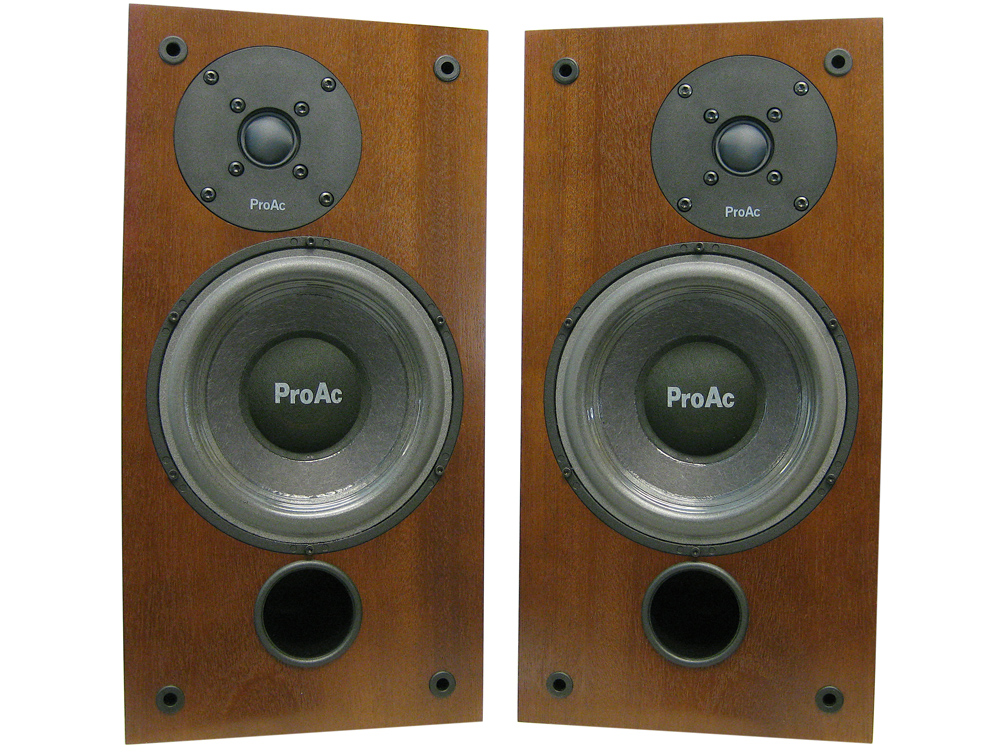
ProAc Studio 100 near-field monitors


"The ProAc Studio 100 is consistently selected by top recording engineers for near-field monitoring in major studios - ample testimony to its overall sound quality and neutrality at monitor reference levels......"


                             http://www.vintageking.com/ProAc-Studio-100-Pair

Foote Control Systems P33S stereo compressor


The features are as follows;

> RMS or Adaptive NL timings
> 100Hz sidechain HPF
> Feedback mode
> True Power or Algebraic summing mode

Algebraic summing differs from true power summing in that the voltages of the 2 channels are summed into one detector, as opposed to True Power sum, which sums the power of the 2 channels after detection using two detectors.

Sonically, Algerbraic sum mode or ALG, has the effect of widening the stereo image by favoring compression of correlated signal.
This is because more of the mono component is compressed than the stereo image information.

The P33S has the trademark FCS sound at an expected street price of around $1,150.00 USD

Waves One Knob plugins