Monday, April 25, 2011

The RED12 Omni Condenser Microphone is made from shotgun shells!


"The RED12 Microphone is perfect for drum overheads and acoustic instruments such as guitar, mandolin, and violin. The custom assembly achieves the dependable and consistent performance you need for recording inside a compact, aesthetically pleasing shell that is as unique as it is bad ass.  

These omni microphones are built into an actual spent 12-gauge shotgun shell casing!"
Talk about going GREEN!
http://www.12gaugemicrophones.com/

White iPhones will be available at Best Buy on Wednesday April 27


 This pic is from an article on 9 to 5 Mac's website about the iPhone being launched this Wednesday at best buy stores.
"both 16 GB and 32 GB white units have already been shipped to Best Buy locations across the United States, so those models should arrive by Monday or Tuesday ahead of the Wednesday launch...."
 Read the full article here: 

Apple signs cloud deal with Warner Music

Apple has reached an agreement with Warner Music Group to offer the record label's tracks on iTunes' upcoming cloud-music service, music industry sources said.
In the race to the cloud, Apple is apparently stepping on the gas. All Things Digital reported Thursday that Apple has signed two of the top four record companies and wrote that Apple content chief Eddy Cue was due to be in New York on Friday to try and finalize agreements with the two still unsigned labels.


Read more: http://news.cnet.com/8301-31001_3-20056528-261.html#ixzz1KXbYqPbd

Sunday, April 24, 2011

On a tight budget but still want that Fairchild sound? Try the UAD Fairchild 670 plugin


There are a couple of plugin emulations of the Fairchild Limiter but UAD's Fairchild 670 is my favorite.
The above pic shows the setting I used for Ricky Martin's vocals on "Drop It On Me" (produced by Luney Tunes). The UAD Fairchild 670 plugin ($149) is a faithful replica of the 1950's hardware 670 which goes for over $30,000 on the vintage gear market. This compressor is one of the most sought after compressors ever made and with good reason. The smooth sonic quality of the unit is unmatched by any other but comes at a high price and requires a great deal of maintenance. Thank you UAD for making this 670 emulation. It's definitely easier on the pocket and allows me to use as many instances as the UAD cards can handle (approximately 76 stereo or 88 mono instances on a UAD QUAD card). The main controls consist of Input Gain, Threshold and Time Constants. The compression ratio is determined by the interaction between the input and threshold controls similar to the LA2A. The attack and release of the 670 is controlled by The Time Constants which has 6 modes. Mode 1 is the fastest, 4 the slowest and 5 and 6 are program dependent. The Metering, Link / Unlink and Output controls are self explanatory. The DC Bias controls are best left alone unless you know exactly what they do. See the manual for details. The UAD Fairchild is different from most compressors in that it offers the LAT / VERT mode (see AGC switch in pic) which allows you to process the mono and stereo elements of a M / S signal separately. In this mode the left input is for the mono signal and the right input controls the stereo signal. Back in the days of vinyl this was very important as it enabled the mastering engineer to have precise control over the cutting head of the lathe. Too wide or too deep a groove could destroy the vinyl masters. You can use this function in your DAW to play around with the stereo imaging / mono presence of a sound or groups of sounds. In the LEFT / RIGHT mode the 670 acts like a regular compressor / limiter and can be used on mono tracks if so desired. If you unlink the controls it operates as two mono compressors which is a great way to control the left / right balance of a loop, guitars or background vocals. I've used the 670 on a variety of sounds including vocals, bass, drum buss and string sections. For more details on the UAD Fairchild 670 go to http://www.uaudio.com/store/co

ADL 670 Stereo Tube Mastering Limiter


There's no doubt that the original Fairchild 670 was and still is the "Big Daddy" of tube compressors. That's why people don't hesitate to pay over $30,000 for one if they can find it. Unfortunately, most of these units are getting very old and unreliable and don't sound as great as they once did. Well, what if you could buy a brand new one today...with a warranty...for substantially less!!! Can't be...well, guess again!!

The ADL 670 is a perfect copy of the original Fairchild 670. After years of testing and research, Anthony DeMaria Labs has matched part for part the specs and sound of the original unit. Every detail has been scrutinized to perfection...no corners were cut. Yes...believe it or not, ADL has painstakingly sourced all the parts of this puzzle to offer a very limited run on these uncompromised, untouchable sonic giants!!! Many in the past have attempted to reproduce the sound of the classic Fairchild 670 but no one until now has taken it to the level ADL has with the ADL 670 compressor. With it's beautiful "military strength" chassis, stand alone PSU, 20 vacuum tubes and 14 transformers...it doesn't get fatter than this. Call ADL today to find out more.
They also carry direct replacement parts based on original Fairchild 670 design. Please call ADL today for further details: 
845 255-4695


Here's an excerpt from a TapeOp review by Pete Weiss on the ADL 670:


" I was able to check out the ADL 670 and A/B it with a vintage Fairchild
670...running identical material through them with matched settings I would be hard pressed to say there was any difference in the two. They both made the mixes louder and thicker without sacrificing any high or low end or distorting in any audible way."


The ADL 670 can also be purchased at Vintage King:
http://www.vintageking.com/ADL-670-Stereo-Tube-Limiter?sc=18&category=332


FEATURES INCLUDE


  • All tube design (no IC's or chips)
  • All parts are designed based on the original Fairchild 670
  • All capacitors and resisters match values as per original
  • XLR input / output
  • Handbuilt in the USA
  • Heavy-Duty Chassis
  • Handles located on front and sides
  • Great for analog & digital recording, tracking, mastering, as well as live 
  • One Year limited warranty
  • Vents on front and sides for maximum air flow
  • Two 24 volt fans (voltage set at 20 volts for silent operation)
  • One Bottom PCB (Hinged Standoff)
  • One Top PCB (Hinged Standoff)
  • Two Back PCB's

SPECIFICATIONS
+4 input / 600-ohm LoadUnit Gain Clockwise :
15.1dB @ +4 Output
Noise-82.6 with 400-Hz Filter = 89.2
THD0.028% @ 100-Hz : 0.189%
IMD0.100%
Frequency  Response50-Hz............20-k (± 1db)
Input / Output Impedance600-ohm
Output Level+4 or +8 VU (+27 dBm clipping point)
Gain7 db (no limiting)
Attack Time (adjustable)0.2 milliseconds in Pos-1, 2 and 6
0.4 milliseconds in Pos-3 and 5
0.8 milliseconds in Pos-4
Transformers14 total - same as original
Tube Complement-8- 6386
-2- 12AX7A
-2- 12BH7A
-4- 6973
Main Unit Rack Space6-U high, 13-1/2"depth
Main Unit Shipping Weight    


45 lbs

GML 8200 Equalizer- An Industry Standard


The GML 8200 by George Massenburg has been an industry standard for over twenty years that can be found in virtually every major recording studio. The 8200 has five broadly-overlapping bands which offer 15dB of Boost or Cut and adjustable bandwidth (or “Q”) from 0.4 to 4. The lowest and highest bands can also be used as shelving eqs. Its extraordinary resolution, surgical precision,  transparency and tons of headroom have made the 8200 the reference for many other equalizers.
This 8200 gets used on the stereo buss of many consoles but also sounds great on vocals, guitar, piano, strings and brass.


Here's a Youtube video with George Massenburg showing the 8200 being used on acoustic piano:


The GML 8200 can be purchased at Sweetwater Sound:
http://www.sweetwater.com/store/detail/GML8200/

Saturday, April 23, 2011

Joe McGinty's Carousel Studios has an incredible collection of vintage keyboards!

I like this video because it gives you a chance to see and hear a lot of rare and vintage keyboards.


Check out their equipment list on the website at: http://www.joemcginty.com/carousel/

Genelec 8260A Tri-Amplified DSP Monitoring System


"The new Genelec 8260A 3-way DSP system is a masterpiece in electro-acoustic design which features major advances in audio driver technology integrated to a sophisticated enclosure design.

Genelec MDC™ Minimum Diffraction Coaxial Mid/High driver technology takes a big step in perfecting audio quality in professional active studio monitors. This breakthrough in coaxial driver design provides more accurate imaging and improved sound quality both on the acoustical axis as well as off-axis. The extremely smooth frequency response leads to outstanding clarity and definition of the inner details of the music.

The 8260A combines, for the first time, a coaxial driver (MDC™) with a modern waveguide technology (DCW™), ensuring drivers to couple coherently over their full operating bandwidth, as well as creating coincident mid-frequency/high frequency point source.

As a new member of the TEC Award-winning 8200 Series, the 8260A features Genelec DSP signal processing responsible for all loudspeaker functions, such as the crossover filters, driver equalizers, driver position alignment, room response alignment, calibration, and equalization related filters as well as distance compensating delays.

The Genelec Loudspeaker Manager™ (GLM™) software manages all these functions allowing the 8260A to be used together with other 8200 Series DSP monitors and 7200 Series subwoofers in the same setup. Genelec AutoCal™ automated room calibration and sound system alignment method provides consistent and accurate frequency response for a multichannel audio system in widely varying room environments.

The 8260A is housed in a die-cast aluminum Minimum Diffraction Enclosure™ (MDE™) with acoustically optimized rounded edges to prevent diffractions and yielding superb sound stage imaging. The robust enclosure is also completely immune to vibrations. Each 8260A also comes with an Iso-Pod™ (Isolation Positioner/Decoupler™) which eliminates coloration of the sound by decoupling the monitor from its mounting surface. For ideal mounting in differing environments, the 8260A includes integrated rear support points for various floor and wall stands."

Check out the video explaining the features of the 8260A:


The world’s best selling wearable HD cameras for sports.


"Developed for professional use, but at a consumer price, the HD HERO line of wearable cameras capture full HD video rivaling brands costing 10x the price. How? Their team consists of some of the the brightest minds in Silicon Valley who also happen to be obsessed with outdoor sports, race cars, and all things moto. Athletic super geeks? Indeed."

Visit http://gopro.com/products/ for more details and pricing.


Looking for a better pair of Earbuds? Try the Radius Atomic Bass 2 ($40)


"Radius Atomic Bass 2 earphones deliver the highest level of sound quality, superior construction, unrivaled comfort and unparalleled style. If you have small ears, large ears or any size in between, these ultra-light aluminum eabuds are designed to fit comfortably and secure and are as functional as they are fashionable. Radius Atomic Bass earphones are a must have for individuals with an active lifestyle."
"The Atomic Bass earphones' understated design is further promoted by the supercompact size of the buds. Even users with smaller-than-average ears should have no problem achieving a relatively secure and comfortable fit. Radius includes three sizes of silicone ear tips, and I had no trouble getting a good fit with the smallest of these. I found the earphones to be comfortable after more than two hours of wear". - (CNET)


Slate Digital VCC with video review by Emeraz


Its been called one of the most anticipated plugins of the decade. The Virtual Console Collection or "VCC" as it's been known, captures the sound of some of the most legendary analog consoles in the industry. Using the VCC, your digital mixer will take on the life and vibe of these great desks and will give your music the depth, dimension, space, and 3D image that you have been craving!


"The Slate Digital "VIRTUAL CONSOLE COLLECTION" brings the sound of 4 of the world's top analog consoles into your DAW workstation. "Slate Digital CTO Fabrice Gabriel and I studied these consoles inside and out. We meticulously modeled the entire circuit path so that we could recreate every subtle nuance that makes these consoles the legends that they are", says Slate.
The VIRTUAL CONSOLE COLLECTION consists of two plugins, Virtual Channel and Virtual Mixbuss. Each plugin allows the user to choose from one of four modeled consoles. Virtual Channel is applied on individual mixing channels. Virtual Mixbuss goes on the first insert of the master fader. "When using the Virtual Console Collection, your DAW instantly takes on the personality of a real analog mixing desk. The imaging and depth improves, instruments sit better in the frequency spectrum, and mixing becomes easier and more musical. You can even push the DAW faders up to find each mixer's "sweet spot", says Slate."


http://www.slatedigital.com/vcc.php
Here's a video review of the Slate Digital VCC done by Steve at Emeraz

Sonnox Oxford Equalizer Plugin


I have been using Sonnox plugins since they were known as Sony Oxford and the Sonnox Oxford EQ Plugin is one of my favorite equalizer plugins. It's extremely flexible and transparent and has allowed me to perform sonic surgery on many mixes.The equalizer consists of 5 bands. 2 of which are Low and High shelving types. All bands have sweepable frequencies and bandwidth which allow you to dial in just the right amount of boost or cut thats needed. There are also two Shelving filter bands and their slopes vary from 6 to 36 db/octave. I particularly like the fact that no matter how much boost is applied, the equalizer remains natural and smooth sounding. It has four different types of equalizers which can be selected right above the A - B switches.
TYPE-I is reminiscent of the SSL E 4000 series consoles and works great on drums and percussion.
TYPE-II is great for precise surgical eq.
TYPE-III is based on British (Neve) type equalizers and is great for bass guitars, keys, strings, etc.
TYPE-IV is a Constant Power Equalizer which is great for using on the stereo buss and or mastering as it provides subtle adjustments with wide bandwidths over a broad frequency range.
The Sonnox equalizer also has a GML option which only runs on Protools HD/TDM and sounds amazing on vocals.

For further info and to download a demo go to

Friday, April 22, 2011

Overloud's BREVERB - great sounding, flexible and reasonably priced reverb


BREVERB offers high-quality musical reverb processing with a flexibility previously available only in extremely expensive hardware reverbs. BREVERB is also engineered to achieve the highest levels of musicality helping you to place it perfectly in any mix.
Unlike convolution reverbs (a reverb that reproduces the real impulse response of a real hall) which recently have gained a lot of popularity, BREVERB allows you to vary the nature of reverberation through several parameters, giving you the flexibility and real-time feedback that has always been a prerogative of the most famous studio digital reverbs.

Features
  • 4 main Algorithms: Hall, Room, Plate and Inverse
  • Modeled after the most sought-after hardware units
  • Each Algorithm is engineered with no compromises in order to achieve maximum quality
  • Full EQ section to tailor BREVERB frequency response
  • Extended Nonlinear section to forge reverberation shape
  • "Motion" parameters add liveness, musicality and the "air movement" of a real room
  • The analog output section of the hardware unit has been emulated for reproducing their personality
  • With dynamic parameter, the input level can control Time, Mix and EQ
  • Two different user interface modes: compact and hardware-like
  • Six fully assignable and automatable hardware-like faders
  • Full automation through host sequencers
  • Realtime Midi control off all paramters through the six faders
  • No additional latency introduced
  • Very low CPU usage: 120 stereo instances safely opened on a Core2Duo 2.4 GHz MacBookPro
  • Host-sync of all rates and times

 I will do a full review on the BREVERB very soon including actual mix use.

Nintendo's Wii 2 will have HD and touchscreen controllers


"Nintendo’s next generation Wii console — currently codenamed “Project Cafe” — could land later this year, and it may sport a new controller with a touchscreen display. A user in the NeoGaf forums has posted several images that provide additional details on Nintendo’s rumored system. According to the photos, “Screen Stream takes the 1080p image and pushes each rendered quarter to the player’s personal TV screen,” which is on the controller itself. So if you’re partaking in a four-player game, for example, you’ll be able to view your slice of the HDTV screen directly on your controller. Similarly, we imagine instances where a gamer could manage his or her character’s traits or abilities directly from the controller itself, without having to pause the game for everyone to access game menu options. IGN says the Nintendo Wii 2 will likely cost between $350 and $400, will offer 1080p output with possible support for stereoscopic 3D, and will run a newer version of AMD’s R700 GPU"

Stereo Image Enhancement/Widening Tips


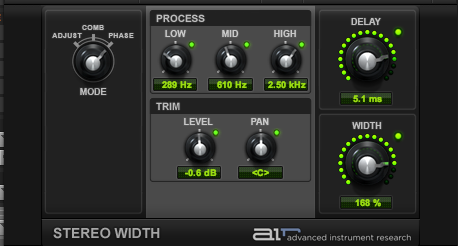
Protools Air Stereo Width


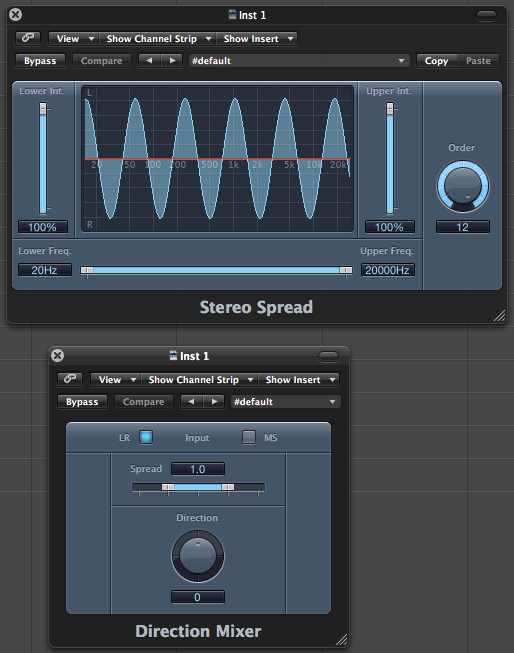
Logic Pro Stereo Spread and Direction Mixer
Stereo enhancement plugins are great mixing tools but can cause issues with your mix if used improperly.


Here are a few suggestions on using a stereo enhancer:
1. Always check the mix in mono as stereo wideners wreak havoc on phase. Pay special attention to the low end as it can sound thin and lack punch when the stereo enhancer is improperly set.
2. Use the stereo widener on individual sounds or aux/group busses. I'm not a big fan of using stereo enhancement on the 2-buss/master (but if you do remember tip #1).
3. Use stereo wideners sparingly. Less is more. The contrast between the mono, slightly panned and wide elements is what creates the illusion of a super wide mix. Don't widen every sound just the ones that make the mix interesting.
4. Experiment with using stereo wideners on the efx returns instead of the direct sounds. You can use more drastic settings without the direct sounds losing presence or mono compatibility.
5. Don't pan all your stereo sounds hard left and right. This will give you what we call wide mono and increases the chances of sounds masking each other. Try panning some sounds this way:
LEFT (hard left) -RIGHT (slightly right of center) and RIGHT (hard right)- LEFT (slightly left of center). Experiment with different panpot settings to hear what works best for the song.
6. All sounds don't have to be stereo. Mono sounds take up less space in your stereo field and with proper panning can seem bigger and wider than it would in stereo. (Tip: Pan your mono sounds to one side and it's effects to the opposite side.)
7. Use EQ to make your sounds appear wider by eq'ing the left and right sides differently. If you boost  certain frequencies on the left cut them on the right and vice versa. Make sure to listen and adjust for level differences. I've used this trick many times when mixing on an analog board. It's also a great way to create pseudo stereo sounds out of a mono signal.
8. Use chorus, phasers, short delays etc. to widen the stereo image. This works great on vocals and lead instruments. Pay special attention to the delay parameters a small difference in the left and right delay times can make a huge difference in perceived wideness of a sound.
9. Experiment. Experiment. Experiment. 

Most DAWs have stereo enhancers as part of their stock plug-in set (Protools' Air Stereo Width, Logic Pro's Stereo Spread and Direction Mixer pictured above) but one of the most well known is the S1 Imager from Waves Audio. There are other stereo enhancers such as Brainworx bx_solo, Flux Stereo Tool (both of which are free) PSP StereoPack and DrMS Spatial Processor plugins.


Brainworx bx_solo
Flux Stereo Tool
PSP StereoPack
DrMS Spatial Processor
As far as hardware enhancers go two of my favorites are the SPL Classic Vitalizer (there's also SPL's high-end Tube Vitalizer which is available as a plugin) and the Behringer Edison. I've used both of these units on many mixes in the past. Another great hardware stereo enhancer is the SRS MW-02 MegaWide Processor.


SPL Classic Vitalizer


SPL Vitalizer MK2-T plugin


SPL Tube Vitalizer

Behringer Edison


SRS MegaWide Processor
The SPL Vitalizer, Behringer Edison and SRS MegaWide are discontinued but can be found on Ebay.
A great feature of both the SPL and SRS units are the bass controls which allows you to shape or contour the low end and controls to enhamce the midrange clarity in addition to enhancing the stereo image. The Edison has a built in Phase meter and a Center Distance control which allows you to change the depth of central elements in the mix such as the lead vocal.

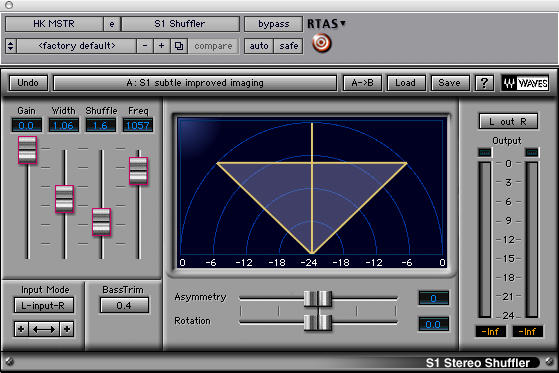
Here is a snapshot from an actual session and a review I did earlier of the Waves S1 Shuffler plugin:


I used the Waves S1 on Estelle's song "Star" (produced by Kardinal Offishall) which is featured in a Crystal Light commercial. The S1 is a spatial enhancer that can be used to correct or improve the stereo image of a mix or group of sounds such as background vocals, synths, strings etc. The S1 has several controls. The gain slider adjusts the overall level of the S1. Width controls how much the sound stage is widened or narrowed. A width of 1= no change, less than 1 = narrower sound stage and more than 1= wider sound stage. Shuffle controls the width of the the bass frequencies. This helps to make sounds appear wider than they really are because if the way our hearing works (we tend to hear bass frequencies as having a more narrow sound stage than mids and highs). A shuffle setting of 1 means no change and 3 is maximum width. Freq chooses the frequency below which the Shuffle will affect the signal. Bass Trim adjusts the level of the bass after the Shuffle has been applied. 0 is neutral. NOTE: Always monitor in mono after making changes with the S1 to check for mono compatibility and phase issues. Asymmetry is useful for altering the far left and right of the sound stage without affecting the center image. Rotation allows you to change the centering of the sound stage without affecting the relative levels of the sounds. (Click and drag in between both faders to move them both at the same time) The input mode buttons allow you to flip the phase of the input channels independently of each other (great for fixing out-of-phase stereo sounds) and also to process M-S (Mid/Side) material. The L out R output button sets the S1 output to L/R (Stereo) or M-S(Mid/Side). For an explanation of M-S see: http://emusician.com/mag/emusic_front_center/ 

For more info on the the Waves S1 Stereo Imager series visit: http://www.waves.com/Content.aspx?id=275

To purchase the S1 Imager as part of a Waves bundle visit B&H Photo, Video and Pro Audio at: http://www.bhphotovideo.com/c/product/213413-REG/Waves_GNB_Gold_Native_Bundle.html


If you come up with a new/different way of enhancing your stereo sounds feel free to post it in the comments. I will add it to the blog and credit the author.

Police knew about, used iPhone tracking logs.


"Law enforcement agencies have known since at least last year that an iPhone or iPad surreptitiously records its owner's approximate location, and have used that geolocation data to aid criminal investigations.
Apple has never publicized the undocumented feature buried deep within the software that operates iPhones and iPads, which became the topic of criticism this week after a researcher at a conference in Santa Clara, Calif., described in detail how it works. Apple had acknowledged to Congress last year only that "cell tower and Wi-Fi access point information" is "intermittently" collected and "transmitted to Apple" every 12 hours.
At least some phones running Google's Android OS also store location information, Swedish programer Magnus Eriksson told CNET today. And research by another security analyst suggests that "virtually all Android devices" send some of those coordinates back to Google."


Read more: http://news.cnet.com/8301-31921_3-20056344-281.html#ixzz1KGFOUYmO

If you record live instruments you need this plugin


Sound Radix Auto-Align is an automatic microphone time alignment plug-in.
Time-aligning a multi-microphone setup is crucial to achieve coherent and punchier sound. When recording an instrument with more then one mic, sound tends to reach each microphone at a slightly different time and thus cause some frequencies to cancel each-other while other frequencies can build-up unnaturally.

Auto-Align will "listen" to your multi-mic recording and will automatically measure and compensate for the delay between the microphones - sample accurate.

When distant microphones are used and a delay is desired to preserve a sense of space, Auto-Align can time-place the microphones to better match the close-mic'ed source.

For more information and to download the trial version please go to
:
www.soundradix.com