Tuesday, April 19, 2011

Hennessy Hands Creative Account to Droga5

The independent shop was not believed to be on the original list of contenders -- a lineup that people familiar with the pitch said included Interpublic Group of Cos.' McCann Erickson; MDC Partners' Kirshenbaum Bond Senecal & Partners; and an agency team compiled by Havas. But in the end Droga5 walked away with the account, which tallied $9 million in domestic measured media spending last year, according to estimates by Kantar Media.
Incumbent agency WPP's Berlin Cameron was invited to pitch but declined to participate.
Hennessy, owned by luxury conglomerate LVMH Moet Hennessy, did not comment on the process, other than to confirm Droga5 as the winner. Agencies either declined to comment or could not be reached.
Hennessy is the No. 1 cognac brand worldwide, with sales of 50 million bottles a year. U.S. sales edged up 2.4% in 2010 to $57.4 million, according to SymphonyIRI.
The brand, founded in 1765 by an Irish aristocrat, has in recent times been bolstered by popularity in the hip-hop community, but seems poised to try to broaden that base to all urban consumers.

Heineken Switching U.S. Agencies as It Pursues Global Effort

The competition, to be concluded by mid-May, comes as the importer seeks to align its U.S. advertising with the efforts of its Netherlands-based global parent. The move will mark the fifth creative agency for Heineken lager since 2006, as the brand has struggled to emerge from a long-running sales slump. It's also the first big change under new Chief Marketing Officer Lesya Lysyj, a former Kraft Foods marketer who took the reigns at White Plains, N.Y.-based Heineken USA in February.
"We've got this great global strategy that need to find the best partner to help us translate that to the U.S. market," Ms. Lysyj told Ad Age. "What we're looking to do is consolidate the business under one of the two agencies that work on the Heineken brand globally," she said, adding that "we think that approach makes the most sense given where we are going as an overall worldwide company."
The pitch will be handled out of the New York offices of both agencies. The importer is already tapping the global approach in the U.S. for Heineken, running TV commercials by Wieden & Kennedy, Amsterdam, called "Open Your World" that position the Heineken drinker as a worldly, confident and open-minded consumer. The spots are running in some 50 countries. The brewer has worked with the Paris office of Publicis on tactical ads and print work, said Alexis Nasard, its global chief commercial officer. "It's an agency that actually can operate with a lot of creative agility," he said, noting that they have deftly navigated around rules in some countries such as Russia that prohibit showing people drinking beer in ads.
Heineken lager had $58 million in domestic measured media spending last year. All Heineken USA brands had $124 million in domestic measured media spending in 2010, according to Kantar Media.
Euro RSCG, which won the Heineken brands in 2009, will remain the agency of record for Dos Equis, which has enjoyed big growth thanks to the popular "Most Interesting Man in the World" campaign. But the Heineken brand has struggled in the U.S., with shipments dropping 4.9% in 2010 and market share declining from 2.3% in 2008 to 2% in 2010, according to Beer Marketer's Insights. If Wieden & Kennedy wins, it'll be getting a second crack at the brand, after running a campaign as recently as 2008.
Wieden is a "very progressive, creatively driven organization ... and I think as a client you have to embrace that and I'm not sure we were as ready for that a couple of years ago as we are now," said Ms. Lysyj, noting that she wasn't at the importer when those decisions were made. Said Mr. Nasard: "Changing agencies this frequently is not great, let's admit that, however when we do it behind the principle of global consistency with an exiting basis of coloration and a well-defined brand strategy and campaign, you'd hope the chances for endurance would be higher."
The new agency's first task will be Heineken Light, which for now is only sold in the U.S. and whose sales at grocery have dropped 14% in the year ending March. 20, according to SymphonyIRI, which does not include liquor stores and Walmart. The importer is looking to replace the "See the Light" campaign with a new effort this summer.

Hispanic Beverage Brand Jarritos Turns Focus to U.S. General Market With GSD&M Assignment

A leading Hispanic brand is now turning its sights to the U.S. general market.
After a swift review, Novamex, a maker of Mexican soft drinks, has awarded Omnicom Group's GSD&M national creative and media duties for its Jarritos brand of beverages. David Flynn, marketing director at El Paso, Texas-based Novamex, told Ad Age: "Prior to this, all of our efforts were focused on the U.S. Hispanic market, which we've been marketing to since the 1980s. But as part of the evolution of the brand -- as all brands are looking to grow -- we want to sell product in the general market."
According to Mr. Flynn, awareness in the Hispanic market is now more than 90%, and there is "pretty strong awareness" in markets with large Hispanic populations, such as Los Angeles. But the company is attempting to make Jarritos a more mainstream beverage that appeals to a diverse consumer base.
"The brand has been growing tremendously over the past 20 years and we think that it's going to find very good acceptance in the general market," Mr. Flynn said. "We did an extensive amount of general-market consumer research to measure [taste] and we found a very positive reaction to the flavors, the glass bottle and the colors. All have natural sugar and some are naturally flavored. When [consumers] try it, or they see it at a food truck, they become converts."
To help propel the brand on a broader stage, Novamex conducted a quick review process of small to midsize agencies on both coasts. Mr. Flynn declined to identify the contenders, but said the shops were in Los Angeles, New York, Kansas City, Dallas, San Francisco, and Austin -- where GSD&M is based. According to him, GSD&M was the largest of the group.
"We knew that the really big mega agencies were going to be way to big for us and we also looked at GSD&M because we knew they were a maverick, different kind of agency that would get excited about the brand," said Mr. Flynn. "We saw seven ad agencies in face to face three-hour presentations over the course of a week. It was rather grueling. From the time that we started looking and doing research on agencies to the time we got a campaign idea delivered to us by GSD&M, it was no more than five weeks."
The budget for advertising is relatively small -- between $5 million and $10 million, according to people familiar with the matter -- and so new work for Jarritos is expected to draw heavily on social and digital media, with events and other activations in local markets slated to appear beginning in July.

Google Video will shut down April 29, two years after it acquired YouTube

Google tried manhandling the online video industry with the hopes of competing with YouTube when it created Google Video in January 2005; the product quickly became a minor contender when it couldn't compete with the global giant. However, on April 29, Google Video will shut down for good and all existing videos on the platform will be inaccessible. Emails were sent out to Google Video subscribers last week to remind them that videos no longer be viewable.
A new download button appeared on the website and Google is encouraging Video users to upload videos to YouTube instead, which it acquired in 2006. YouTube has since made for a sizable chunk in Google’s revenue stream, attracting more than 2 billion video views per day. In 2009, Google Video stopped accepting new video uploads, adding to the dying fan base and service.
See top stories in the WDM Content Network:
• Top Ten Biggest Brands
• Why your Personal Information is a Hot Commodity on the Internet 
• Click here to read the latest edition of Business Review USA 
According to PC World, Michael Cohen, Google Video’s product manager, wrote on the blog that the search engine was stopping uploads from users in order to focus on video search – what Google is best known for.
In the email sent out to Google Video users, the company writes:
“We’ve always maintained that the strength of Google Video is its ability to let people search videos from across the web, regardless of where those videos are hosted. And this move will enable us to focus on developing these technologies further to the benefit of searchers worldwide.”
Google Video users have until May 13 to download their videos before they will be removed permanently. Considering Google owns YouTube, you think they would have made for an easy transfer from one video platform to the other. That way, lost Google Video users could stick with a Google brand, adding to the company’s loyal customer base.

Apple Ends MobileMe & iWork Rebate Programs

Screen shot 2011 04 19 at 09 42 10
In an internal memo to its employees, Apple has announced the end of its iWork and MobileMe rebate programs with effect from close of business on April 18th. The rebate programs allowed customers to save $30 on MobileMe when purchasing a new Mac or iPad, and $30 on iWork when purchasing a new Mac.
The termination of these programs follows reports that Apple is set to revamp its MobileMe service over the coming months. A new MobileMe service, said to feature a digital “music locker” for streaming content from the cloud to Apple devices – as well as the “Media Stream” and “Find my Friends” features – is rumored to launch either later this month or at WWDC in June.
Though it’s not clear why iWork was also cut from the rebate program, it’s believed this is simply due to the release of iWork 2011 later this year. I think the the Mac App Store could also play a part in this: if Apple has decided to offer future iWork releases exclusively through the App Store as separate purchases, there may be a new way for customers to claim rebates – such as promo codes – or no rebates at all.

Monday, April 18, 2011

Neve 2254 Limiter / Compressor

 
Pictured above is the more desirable version 2254E with variable attack on the limiter section. Pictured at the bottom of tha page is the original 2254 with switched limiter attack and fixed compressor threshold.
performance: The Neve studios limiter/compressor type 2254A has been designed to meet the varied needs of sound recording studios for a flexible and comprehensive instrument for the control of progarmme dynamic range.
specifications:
input:10K ohm bridging earth-free
output: Source impedance 80 ohms, balanced and earth-free
maximum output +26dbm into 600ohms
gain:0db (preset)
noise:-75dbm in the band 20Hz to 20kHz for the linear and Limit modes rising in the compression mode with an increase in 'MAKE UP GAIN' to a maximum of -60dbm at 6:1 ratio
frequency Response: Flat, within 1db, from 20 Hz to 20 kHz

distortion: Typical results measured at +8db out and with 800ms recovery time are: residual, linear mode-0.05%. Compression mode, 6:1 ratio-0.2%
limiting mode@20db input -0.4%

limiter:
ratio: greater than 100:1
level: +8dbm within 0.5db on preset, adjustable from +4dbm to +12dbm in steps of 0.5dbm
attack Time: 5mS
recovery Time: 100mS, 200mS, 800mS, and 'Auto' 50mS/5 sec.

compressor:
ratio: 1.5:1, 2:1, 3:1, 4:1, 6:1.
threshold: 0dbm, within 0.5db on preset, adjustable from-20dbm, to +10dbm in 2db steps.
attack time:5ms
recovery time: 400mS, 800mS, 1500mS/5 sec
gain:0db below compression threshold, adjustable 'Gain make up' available from 0db to +20db

meter:
switched to indicated either gain control up to 16db or signal level from -12db to +12db. Action approximates that of a P.P.M

If you work with sound take a moment to visit this site.

House Research Institute
http://www.hei.org/education/soundpartners/sp.htm
"As a world-renowned hearing science and medical institution focused on developing new treatments for hearing loss and related disorders, the House Research Institute is uniquely positioned to help audio professionals through its Sound Partners program."

Thanks to Madam Asuka (@MadamAsuka) for the link.

DMG Audio EQuality EQ plug-in


Dave Gamble formerly of Sonalksis, Focusrite and Novation designed the EQuality plug-in.
"It has nine bands (four bell/notch, two shelf/bell, dual high-pass and one low-pass), five EQ styles, M/S processing, a spectrum analyser, foldable interface and more."
The Range slider scales the gain of all bands simultaneously, from -36dB to 36dB, with the negative settings enabling you to 'flip' your EQ curve, so boosts become cuts and vice versa. There's a global EQ frequency Shift slider too, working as a multiplier ranging from 0.5 to 2.
Next up, you'll find that the shelving bands have their own Shift knob, with which you can move their points of resonance. The gain/Q interaction is fully adjustable - with higher settings, increasing gain narrows the Q, which is a feature associated with analogue EQs.
Rounding things off is the 'auto listen' option, which solos the band you're modifying, to assist with fine-tuning and locating problem frequencies. Amongst the many preferences are meter ballistics and scaling options (VU, PPM, digital, BBC, full scale, Kf12, Kf14 and Kf20).

Modes

"EQuality includes five EQ modes. For most uses, DMG suggests using Digital or Digital+, the latter having a slightly more accurate high-end response. Both are zero-latency and CPU-efficient. It's worth saying that these modes have been designed to sound 'analogue', so don't be put off by the names.
The remaining three all employ impulse-response-based (FIR) techniques. The Linear Phase option gives zero phase distortion but with some processing latency. The Analogue Phase mode uses a similar technique but instead replicates the phase shifts of an analogue EQ.
Finally, Minimum Phase shifts the energy of the impulse response to the start, so there's no delay and minimal transient smearing. The differences between modes are subtle, but they can become more pronounced if you have other processing following the EQ, such as saturation/distortion."


Drunkness Guide

The Obamas: A two-thirds pay cut in 2010


President Obama and the first family earned about two-thirds less in 2010 than the year before, and donated about 14% of their income to charity.
The Obama family, in tax returns released Monday by the White House, reported an adjusted gross income of $1,728,096, down from about $5.5 million in 2009.

The Obamas reported paying $453,770 in federal taxes. They donated $245,075, or 14% of their income, to 36 different charities. Fisher House Foundation, a charity that works with veterans, took home the biggest single donation.
The president earns a salary of $400,000 for his day job. His paycheck was much higher because his books -- "Dreams From My Father," "The Audacity of Hope" and "Of Thee I Sing: A Letter to My Daughters" -- continued to register strong sales. But those sales were not nearly as strong as they were the year before.
Obama is donating the proceeds from the latest book, "Of Thee I Sing," to a Fisher House scholarship fund for children of fallen and disabled soldiers. This year, the contribution was $131,075.
The Obamas donated $15,000 to the Clinton Bush Haiti Fund, and $10,000 to the Boys & Girls Club of America.
In 2009, the Obamas paid about a third of their income -- $1.8 million -- in federal taxes.
Obama said in a speech last week that top earners -- himself included -- should pay higher taxes.
"I don't need another tax cut," he said. "Warren Buffett doesn't need another tax cut."
Also released was the return of Vice President Joseph Biden and his wife, Jill. Their adjusted gross income was $379,178, on which they paid federal taxes of $86,626.

The Bidens donated $5,350 to charity, in both monetary and in-kind donations, an amount equaling 1.4% of their adjusted income. The biggest donation listed on the tax return is a $1,400 donation to the Northern Virginia Community College Alumni Scholarship Fund.
Elizabeth Alexander, Vice President Biden's press secretary, issued a statement to CNN that emphasized that the Bidens also donate their time to charitable causes.
"The charitable donations claimed by the Bidens on their tax returns are not the sum of their annual contributions to charity. They contribute to many causes with their time, as well as their checkbooks," she said.

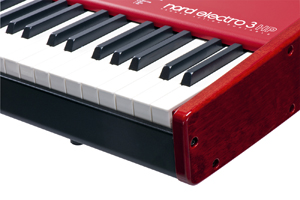
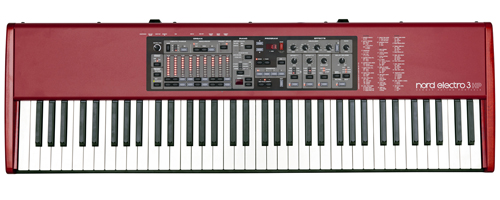
Nord Electro Goes Hammer Action in the New Nord Electro 3 HP

Nord introduced a new version of its popular Electro keyboard at Musikmesse…the Nord Electro 3 HP, a 73-key E-E range keyboard with Hammer Action.
Nord Electro 3 HP = Hammer Action & portability (25 lbs)
Where the original Electro 3 perhaps can be seen as a great organ with additional piano sounds, the new Electro 3 HP gives acoustic and electric piano lovers a brilliant new keyboard that even works great for organ playing styles.
In addition to the new Hammer Action feature, the new Nord Electro 3 HP includes all of the features of the original Nord Electro 3, like the compatibility with the Nord Piano and Nord Sample Libraries — including the exclusively licensed Mellotron and Chamberlin sounds — the tonewheel and transistor modeling of the Nord C1 organ and Rotary speaker simulation.
The Electro 3 HP additionally features a Long Release mode that adds a slightly longer release to Piano sounds, suitable for playing Legato Piano parts, and has a dedicated button for disabling the String Resonance feature temporarily. Nord has also added a flexible new Delay Effect with tap-tempo, rate, amount and a stereo Ping-Pong mode.
The number of Live Locations has been increased from 1 to 4, giving players greater freedom to experiment with new sounds and settings on the go that are automatically saved. Program access is also now easier than on the previous Electro model, requiring fewer buttons to push to find specific programs.
The Electro 3 HP has all the features of the original Electro 3 but sports a new 73-key Hammer Action Portable keybed, with an E-E range and 4 selectable Dynamic Response Curves.
And the Nord Electro 3 HP is just as portable, weighing just under 25 lbs, and includes mounts for the height-adjustable Keyboard Stand EX (optional accessory) and the Music Stand EX (optional accessory). Control Pedal compatibility includes: Yamaha FC7, Roland EV-5/7, Korg EXP2/XVP10 and Fatar VP-25.
The Nord Electro 3 HP is handmade in Stockholm, Sweden by Clavia DMI and is scheduled to ship in late April 2011.

iPhone 5 To Be Released In October With A5 CPU and 8MP Camera

Whether it comes in June or it comes in September as the latest rumors suggest, people aren’t really expecting the hardware to be a shock. It’ll definitely pack Apple’s new A5 SoC as boasted by the iPad 2; it might boast a Qualcomm baseband allowing the same hardware to run on both CDMA and GSM networks; it will probably have a revised antenna design to mitigate the chances of Antennagate II. These are no-brainers.
Analyst Ming-Chi Kuo’s of Concord Securities supports this view of the next hardware, with a twist: she says that the iPhone 5 will be announced in September and start production that same month, but not be released until October.
Kuo’s got a pretty good record here. In the past, he successfully forecast the quality (or lack thereof) of the iPad 2′s cameras, as well as predicted that the white iPhone 4 wouldn’t be released until April of this year. Hardly Criswellian soothsaying, but not bad.
Kuo also claims that when the iPhone 5 is released, it will boast an 8MP camera sensor. We’re guessing he’s talking about this one, which not only will allow the iPhone to shoot in 1080p video, but will also improve image quality by affording the smartphone 35% better low light sensitivity.

Dual-Core iPad 3

Samsung makes some great ARM-based smartphone chips… and even fabricate Apple’s in-house-designedA5 CPU, so when Samsung talks about the future of chips, they’re talking in part the future of the iPhone.
And what is that future? According to a Samsung rep, Samsung is “planning to release a 2GHz dual-core CPU-equipped smartphone by next year” that will have “the data processing capacities of a regular PCs.”
That’s a huge leap in the clock speed of the current A5 SoC, which maxes out at 1GHz per core. It does not appear that Samsung intends on keeping these chips to themselves, though: Samsung apparently hopes to sell the compontents to other manufacturers as well.
Could Apple be one of them? Maybe not, but it seems obvious that Apple will have a chip with similar capabilities available around the same time. If that’s right, then next year’s A6 CPU might boast 2GHz clock speeds per core. Just imagine demoing Infinity Blade on that.

Brazilian Super Model Alessandra Ambrósio

Brazilian Super Model Adriana Lima

Aurora Audio GTM-822 -- 8 by 4 Expandable Console


Input Channels :

• Eight channels expandable by adding additional units and linking the busses

• All inputs and outputs are balanced, line level and able to drive 600 ohms

• All inputs are via a four position gain switch (with classic red Marconi knob) which controls the input gain from +10dB to -20dB, plus another 10dB gain "in hand" in the fader.

• All channels have two inputs, either a 25 pin D sub for mixing or an XLR for tracking. The channels can be switched individually or globally via the blue "tracking" switches.

• All channels have pre-fade insertions and an LED VU meter that monitors the pre-fade insertion return level. By having the meter here, if no insertion is used then the meter follows the input, and if an insertion is used (like a compressor or EQ with high gain) the meter will indicate the level hitting the channel. THe LED has ten segments that range from -20VU to +3VU. All LEDS up to -1 are green, 0,+1 and +2 are yellow, and +3 is red.

• Two main stereo busses have an automatic pan control: Pressing L sends to the Left bus, pressing R sends to the Right bus, and pressing both selects the centre detented pan pot and lights a small green LED for confirmation. If the pan pot is central there is no difference in level and rotating the pot sweeps from +3dB to infinity.

• A pre-fade aux send control, intended as a stereo Cue Send, can also be used as an effects send because a stereo effects return path is also provided.

• The Channel fader knob has 10dB signal in hand and, by plugging a connector into the back of the unit, remote sliding faders can be used to control channel and output levels.

• Illuminated Solo-in-place and Channel cut buttons are at the bottom of each channel. When solo is selected, all channels that are cut will light their red LED in the cut button. Pressing more Solo buttons will release those mutes. The muting is controlled by opto-isolators to minimize clicks and to provide a smooth "cross-fade" perfect for dropping in a channel into a mix.

• A remote fader pack, either rackmountable or desktop, with a choice of either P & G or Alps faders, is connected via a 56 pin Elco connector. Custom cable lengths are made to order (long runs not a problem).


Master Section :

• Two Sifam VU meters and a Sifam Phase meter. The phase meter keeps a watchful eye on the Mono compatibility of the stereo signal.

•A four position source selection switch selects either the stereo output, the stereo playback return, the auxiliary sends, and the PT mix (assuming that it is assigned to channels 1 & 2) the pre-fade signals on these two channels being sent directly to monitor. The buffered VU meters follow the monitor.

• There are switchable outputs to two sets of loudspeakers and a mute control.

• A front panel headphone jack is provided with its own level control. Using the jack socket does not mute the loudspeakers. The output will drive any impedance from 8 ohms upwards and will drive over 7 volts into 600 ohms headphones.

• Master output level controls including Aux send pots. The Stereo output has individual level controls and a master cut switch.

• A Stereo effects return input with cut switch acts, in effect, like the ninth and tenth input to the mix bus.

•An illuminated blue "TRACK" switch changes the sources, globally, to the channels from "MIX" inputs on the 25 pin D sub to Track inputs on the rear panel XLR's. The channels can also be switched individually by the blue "TRACK" buttons on each channel. The channel outputs are available on the output 25 pin D sub and can be used to send mic pre-amplifiers signals to Pro-Tools (or other DAW) for tracking while the other channels are used for mixing.

• The rear panel has Neutric XLR's for channel inputs and channel direct outputs. These connectors are linked (via relays in the case of channel input) to two 25 pin D-Subs for Pro -Tools ® interconnect cables. All other inputs and outputs are on balanced TRS 1/4" jack sockets and all signal are balanced, line level.


Sonum H2O Preamplifier/D.I.


"Sonum H2O is a class A, discreet-component preamp and it stands out for its incredible overall gain (+69dB), transparency, transient-processing speed as well as for being completely noiseless. In other words: an outstanding professional Line and Hi-z mic preamp.

The internal innovative architecture and its electronic components, which have been carefully selected, have made this product totally different from the other manufacturer's currently on the market. Most notably, H2O is the only real "neutral preamplifier" available today for the standard API 500.

In addition to an unprecedented and innovative architectural formula for the best possible performance, H2O features 48 volt Phantom Power which is gradually managed in order to avoid damage to any linked devices, -17dB active Pad button and a signal Phase button. 
Another useful feature is the 12 micro led Vu-Meter with overload and memory function, that holds in memory the saturation value for a few seconds. "


http://www.sonum.it/en/Products.html